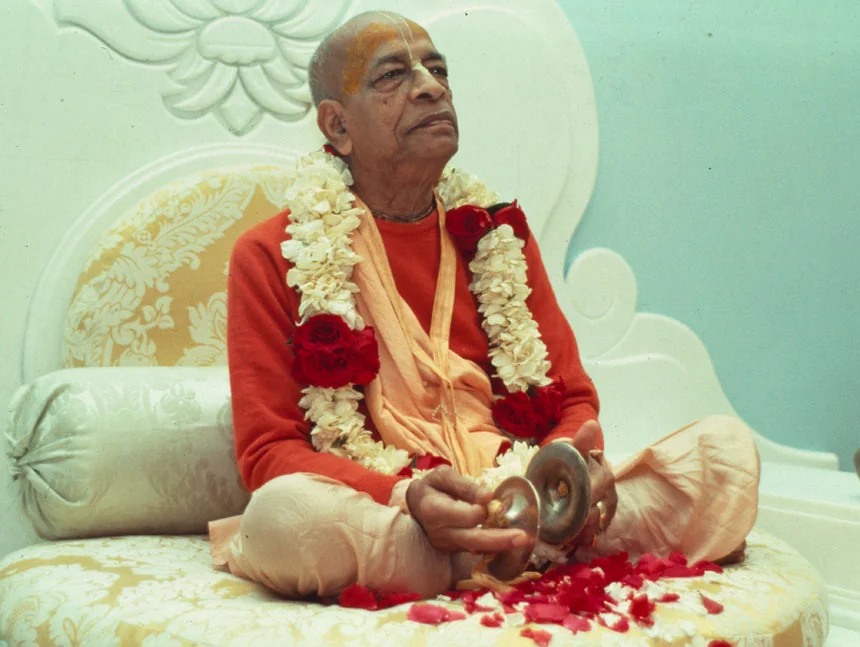
Loving disciples prioritize their guru's direct care over safety, demonstrating faith transcends calculated risk assessment.Listen — Srila Prabhupada Uvaca
Tamāla Kṛṣṇa: ...may request him that "Since you feel that it is very important that Prabhupāda gain a little more strength, you kindly wait about two more days, and let us go like that." In other words, we're not overly eager to leave tomorrow. If the kavirāja were willing to stay here for ten days more, we'd be very happy, and then after ten days we'd go with him. Prabhupāda: Yes. Tamāla Kṛṣṇa: So let us try and in some way induce him to extend, as far as he can, and then we'll go on whatever day he says he must go on. Bhakti-caru: Actually he agreed to stay about three more days. Tamāla Kṛṣṇa: Huh. If he agrees to stay a couple more days, we should take advantage of that to give you more time to gain strength. Not that we're overly eager to rush out of here.
Our point is that we want to go where he is, that we want you to remain under his treatment. That is our point. If he was willing to stay... Prabhupāda: No, no, if after all he wants to go, why not leave earlier? Tamāla Kṛṣṇa: Because the whole idea of going is that the medicine is supposed to be having effect. So the longer we have for the medicine to take effect, the stronger you should become.
And the stronger you become, the easier will be the journey. It would only be a question of one or two days extra, because in any case he'll want to leave after a few days. [break] Prabhupāda: ...some rest, back side, I can sit down. Tamāla Kṛṣṇa: With some rest? Bhavānanda: Something to rest against on his back. Then he can sit. Tamāla Kṛṣṇa: Yes, and in any case we were going to purchase three seats for you, for Your Divine Grace, so that you can lay down conveniently in the plane also.
No harm in taking... Because one thing you have to remember: the entire journey will take ten hours, so you should conserve your strength by laying down as far as possible. Here you can sit up for two hours because the bed is stationary, and then you can always be resting. But this will be a ten-hour journey.
So we should try to take every possible means to allow you to be comfortable the whole way and to relax as much as possible. Prabhupāda: Give me some rest, back side. Tamāla Kṛṣṇa: Pillows. There's a couple in that room, also in the palanquin. Prabhupāda: Hmm? Bhavānanda: Just setting it up, Śrīla Prabhupāda. [aside:] We just have to move your bag. [break] Prabhupāda: Bhakti-caru. Bhakti-cāru: [Transl. Yes, Śrīla Prabhupāda.] Prabhupāda: [Transl. You discuss about that.] Bhakti-cāru: [to Tamāla Kṛṣṇa: Prabhupāda is asking if you [indistinct—mic moving]. Tamāla Kṛṣṇa: So Śrīla Prabhupāda seems to be feeling a little bit of benefit already from the treatment. [Bhakti-caru translates to Kavirāja] Bhakti-cāru: [Transl. He is saying that Śrīla Prabhupāda is feeling better from the medicine.] Tamāla Kṛṣṇa: So he's... He feels a little confident under your care. Bhakti-cāru: [Transl. He has confidence in your medicine and treatment.] Tamāla Kṛṣṇa: So he's feeling that whenever you like to go to Calcutta, as you have other important business there, that you take him with you and we'll all come. Bhakti-cāru: Prabhupādajī has said that whenever you go back to Calcutta, as you have so much work there, you take him along with you. Kavirāja: [Transl. So Mahārāja, what do you say?] Prabhupāda: [Transl. I agree.] Kavirāja: [Transl. You agree? But I like to take you only after ten to fiteen days. When you start to walk, when swelling reduces.] Tamāla Kṛṣṇa: The thing is that Prabhupāda does not—neither we feel confident at all—to have Prabhupāda treated by anyone else even in the interim period. Bhakti-cāru: [Transl. We have no faith in others, Śrīla Prabhupāda has no confidence, and we also have no confidence in treating Prabhupāda by another Vaidya.] Kavirāja: [Transl. But in this condition, according to medical consideration, it is not proper to take him. I can take him, I can reach him there, this much I can do as I have full faith in my medicine. I will give such medicine that he will remain fit for ten, twelve hours. But in this present condition, he is extremely weak, and the climate here is much better than the climate there. This is the point. Here the climate is dry.] [Someone whispers translation to Tamāla Kṛṣṇa] Tamāla Kṛṣṇa: The problem is that if some assistant is here, if in case there's some problem develops, then the assistant has to become the one who gives a diagnosis, and we don't trust any assistant. [Bhakti-caru translates; kavirāja answers] Bhakti-cāru: [Transl. If suppose you are not here and you leave behind an assistant, and by chance some problem develops then the assistant has to make a diagnosis.] Kavirāja: [Transl. His main disease is being treated and slowly he will be cured. There is no problem with that. Now his cough is just a symptom and it will be taken care of immediately. His nature is very delicate. He cannot tolerate coughing. If he passes stool more than two times he cannot tolerate. To take care of these secondary symptoms I will instruct my assistant. Don't worry, there will be no problem. Main diagnosis is already done and I will prepare the medicines for that. As he takes ark regularly, his kidney will function better. When his kidney works nicely, his appetite will come. And when there is appetite his food will be digested. So the condition will change and improve on a day to day basis, from today to tomorrow, from tomorrow to day after tomorrow like that.] Bhakti-caru: He's saying that the main disease is being taken care of, but there might be some secondary ailments like a cough or like passing stool. Someone has to take care of these sort of things, the secondary effects. But the main thing he is giving the medicine, and that he's going to give. Tamāla Kṛṣṇa: But the fact is that no matter how expert one may be, sometimes the body reacts in a certain way. Sometimes the body may react in a way which was not foreseen. And then we are at the mercy of this assistant. And that we do not want. This assistant is... We are not very anxious about him. [Bhakti-caru translates; kavirāja answers] Bhakti-cāru: [Transl. What if by taking the medicines he suddenly becomes more sick, because Prabhupāda's body is very delicate, but you are not present here.] Kavirāja: [Transl. The thing is that the medicines that I have given him, so far there has not been any bad effect. It has been good so far. I have already been here three days and tomorrow again I will examine him. Actually the effect of the medicine, if there is any, will be immediately and not later on.] Tamāla Kṛṣṇa: No person of any great position would ever place themselves under an assistant like that. [Bhakti-caru translates] Bhakti-cāru: [Transl. No great soul, no big man will depend on the assistant rather than the main doctor.] Tamāla Kṛṣṇa: Never. If Morarji Desai was to be treated, he would never allow that assistant to touch him. [Bhakti-caru translates] Bhakti-cāru: [Transl. If Morarji Desai was in Vrindavan and you are treating him, would you leave him under the care of your assistant and go?] Tamāla Kṛṣṇa: We prefer to take the risk... [kavirāja interrupts] Kavirāja: [Transl. So then tell me what to do? I am in difficulty now.] Bhakti-cāru: [Transl. You tell what should be done?] Kavirāja: [Transl. For traveling...] Bhakti-cāru: [Transl. When Prabhupādajī heard that you...] Tamāla Kṛṣṇa: You can explain this point. We prefer to take the risk of traveling than the risk of being treated by that assistant. [Bhakti-caru translates] Bhakti-cāru: [Transl. Mahārāja is saying that we can take the risk of traveling, but we are not ready to leave Śrīla Prabhupāda under the care of the assistant.] Tamāla Kṛṣṇa: Because if you are personally present, there's less risk. [Prabhupāda comments; Bhakti-caru translates and explains travel plans] Bhakti-cāru: [Transl. Because, we have faith in you, wherever you are, we have faith that everything will go right.] Prabhupāda: [Transl. If you are giving guarantee for twelve hours then in twelve hours we will reach Māyāpur.] Bhakti-cāru: [Transl. Prabhupādajī is saying that if you give guarantee for twelve hours, we will reach in twelve hours. From here to Delhi three hours, the flight will take two hours, from there to Māyāpur another three four hours.] Kavirāja: [Transl. Three, four hours.] Bhakti-cāru: [Transl. Usually we book three seats for him so that he can lie down.] Kavirāja: [Transl. He can travel with ease.] Tamāla Kṛṣṇa: Here's what it will entail. From here we will go in the car, a very good, big Western car with a mattress in the back seat, and Prabhupāda will be laying down. You can explain that. [Bhakti-caru translates] Bhakti-cāru: [Transl. Whenver Prabhupāda travels in this condition, we arrange a big car like Mercedes, Shafole. We put mattress in the back seat and that way we arrange a place for his sleeping. Prabhupāda travels like that while lying down. And those cars are also very good because they don't jerk. It is a smooth riding.] Kavirāja: [Transl. Alright. We can do like that. Let us take him.] Bhakti-cāru: [Transl. Let us take him? When?] Tamāla Kṛṣṇa: We'll drive slowly. Then we'll have a wheelchair at the airport. The car will go right up to the plane and the wheelchair... We'll carry Prabhupāda right into a seat, and he can lay down in the three seats. Then again we'll take him off the plane. Immediately he'll lay down in the car and go to Māyāpur. [Bhakti-caru translates; kavirāja comments] Bhakti-cāru: [Transl. We put Prabhupāda in wheel chair and take him to the plane. In the airport we take Prabhupāda in a wheel chair up to the plane. Then we lift him to the plane.] Kavirāja: [Transl. Arrangements are made like that.] Bhakti-cāru: [Transl. Yes. Arrangements are there. After he alights from the plane again we take him in a wheel chair and go like that.] Kavirāja: [Transl. Everything will be alright. No problem.] Bhakti-cāru: [Transl. Yes, no problem. But we think that we have full faith in you, so without you we cannot take the risk of traveling.] Kavirāja: [Transl. According to the climate and health...] Bhakti-cāru: [Transl. Climate in Māyāpur is very good now. Nowadays it is little cool there.] Kavirāja: [Transl. Very little. In a few days it will be.] Bhakti-cāru: [Transl. Rainy season is over now. There is no question of further rain.] [Svarūpa Dāmodara tells Tamāla Kṛṣṇa they are talking about the climate] Tamāla Kṛṣṇa: There there's open air. Here we have to keep everything closed. Bhakti-cāru: [Transl. Here there is no fresh air. It's not open here.] Tamāla Kṛṣṇa: Cold draft is coming here. Bhakti-cāru: [Transl. If we keep everything open then cold wind comes inside and he feels discomfort.] Kavirāja: [Transl. Yes. He cannot tolerate cold.] Tamāla Kṛṣṇa: And also there all the vegetables are grown fresh on our land. Bhakti-cāru: [Transl. There fresh vegetables are grown on our land.] Tamāla Kṛṣṇa: Plus change of place is also nice for improved health. Bhakti-cāru: [Transl. And by changing the place...] Kavirāja: [Transl. Yes, that will be nice.] Bhakti-cāru: [Transl. Prabhupādjī is like, he is like a perfect yogī and so he doesn't want to stay in one place more than two, three days. But now he is here for months.] Tamāla Kṛṣṇa: Prabhupāda is accustomed every three days to go to another country or another city. [Bhakti-caru translates, kavirāja answers and says something to Prabhupāda] Bhakti-cāru: [Transl. Within three days Prabhupādajī travels from one city to another or one country to...] Kavirāja: [Transl. Yes, that is written about a sannyāsī or yogī that they don't stay in one place for long.] Prabhupāda: [Transl. Hum?] Kavirāja: [Transl. For a sannyāsī, it is written that he can not stay in one place. That is right. You have to move from one place to another.] Tamāla Kṛṣṇa: We will have about ten of us traveling. Kavirāja: [Transl. So make a programme. You can make it for tomorrow or the day after tomorrow.] Bhakti-Cāru: [Transl. Prabhupāda was saying, the day after tomorrow, that is Wednesday.] Kavirāja: [Transl. That is Okay.] Tamāla Kṛṣṇa: There will be at least ten of us traveling, so we will give him all... [Bhakti-caru translates] Bhakti-cāru: [Transl. About ten people will travel with him. There will be three seats reserved for him to lie down. There should not be any problem. Prabhupādajī says that I can sit down. If he can sit down in the plane...] Kavirāja: [Transl. He can not sit down.] Bhakti-cāru: [Transl. If he can not sit, he will lie down. It's better for him to lie down and travel.] [Svarūpa Dāmodara tells Tamāla Kṛṣṇa that the kavirāja said Prabhupāda cannot sit] Kavirāja: [Transl. When we board the plane a dose of medicine for the heart will be given to him.] Bhakti-cāru: Okay. Kavirāja: [Transl. So that if there is any jerking, nothing will happen.] Bhakti-cāru: [Transl. That is a very good idea.] He'll give a medicine for heart, so that if there is any jerking or things, it won't effect. Tamāla Kṛṣṇa: Therefore we want him to take Prabhupāda. [Bhakti-caru translates] Bhakti-cāru: [Transl. That is why we want that you travel with us.] Kavirāja: [Transl. No, we can take him. In this condition we can even take him to London.] Bhakti-caru: He says in this condition he can even take Prabhupāda to London. [chuckling] Kavirāja: [Transl. I was wondering that from the climatic condition his health would have improved here.] Bhakti-caru: He was thinking that due to the climatic condition here, he could have improved better, because it's a dry climate. Tamāla Kṛṣṇa: Where? Here? Bhakti-caru: Vṛndāvana. Tamāla Kṛṣṇa: As opposed to... Bhakti-caru: Māyāpur. Tamāla Kṛṣṇa: The climate in Māyāpur is damp now? Bhakti-caru: Bengal is little damp as compared to North India, I mean U.P., especially Vṛndāvana. Kavirāja: [Transl. For his illness, this country is suitable.] Tamāla Kṛṣṇa: These days here. But unfortunately you cannot stay here. [Bhakti-caru translates, kavirāja answers] Bhakti-cāru: [Transl. But the point is that you can not stay here.] Kavirāja: [Transl. Yes. That is the biggest problem.] [whispered comments by Svarūpa Dāmodara as he translates for Tamāla Kṛṣṇa] Kavirāja: [Transl. Whenever he coughs, thick mucus comes out.] Bhakti-cāru: [Transl. It is difficult to come out.] Kavirāja: [Transl. Today you give him the medicine for cough. Okay?] Bhakti-cāru: [Transl. And there was also problem for arranging the medicines here.] Kavirāja: [Transl. About medicines, yesterday I spent three, four hours. Today I have solved that problem. I have prepared medicines for twenty days for him. That ark will gradually help improve his kidney function. Last night it took me three, four hours. Now I will go and spend about six hours to prepare the medicine. It is not in my house. I have to go out look for them and collect.] Bhakti-caru: I was telling him that... I mean, that he's facing great difficulty preparing the medicines also here. He says that it's been done; dose of medicine for twenty days has been prepared. Like today also he has got to go for six hours, and he's going to make... Tamāla Kṛṣṇa: The main point is that we would very much be glad if he is able to periodically, every day or every other day, whatever the requirement, to check up on Prabhupāda. What we are afraid of is that for twenty days he will not be present to check up. This other man is not competent. Bhakti-caru: No, he didn't say it in that relation also. He just said... I told him that medicine is a big problem. [Transl. Mahārāja is saying, he thinks that you will give medicine for twenty days and go away. If it is like that, see twenty days is a long time, either everyday or every alternative day someone should check him.] Kavirāja: [Transl. Now he will gradually progress. Now for example, last three days I have been observing no deterioration only improvement.] Bhakti-caru: He says during these last three days there has been only development. Kavirāja: Progress. Bhakti-caru: Only progress. [Transl. Regress also] Tamāla Kṛṣṇa: Yeah, we haven't seen anything regressive. Svarūpa Dāmodara: And Prabhupāda is taking rest also, quite comfortably. Tamāla Kṛṣṇa: It appears hopeful. Bhakti-cāru: [Transl. Yes. Since you have come...] Kavirāja: [Transl. His health is good. His health will go on improving. The climate there is good for him. As far as his health improvement is concerned, what will take ten days here, will take twenty days to one month there. This is due to the climatic condition. That's why I was hasitant.] Bhakti-caru: He says that he could have been cured in ten days here, but there it will take twenty days to a month due to the climatic condition. Tamāla Kṛṣṇa: He says that due to climatic condition, what would take ten days to cure here will take twenty days to thirty days in Māyāpur. The climate is not... Kavirāja: [Transl. In Bengal, Māyāpur climate is better than Bengal. Bengal is a state no? Oh, it is Anupadeśa and he has mucus problem. In Anupadeśa the air and mucus increase.] Bhakti-cāru: [Transl. Ānūpa means?] Kavirāja: [Transl. Bengal is Ānūpadeśa, here it is Miśradeśa and Rajasthan is Jāñgaldeśa. Jāṅgaldeśa is even better than here. The climate there is like Swizerland.] Tamāla Kṛṣṇa: But the real issue is this. The real issue is that although we were sitting here in the best climate, Prabhupāda was getting worse until he came. So the real point is not the climate but the doctor. [Bhakti-caru translates; kavirāja comments in Hindi—laughter] Bhakti-cāru: [Transl. Mahārājajī says that the climate here is good, but until you came prabhupāda's condition was getting worse. In fact after you came his health started to improve. So the real question is...] Kavirāja: [Transl. Let us go by chanting the Lord's name. [laughter] What do you say Mahārāja?] Prabhupāda: [Transl. śubhasya śīghraṁ. [anything auspicious should be done immediately]] Kavirāja: [Transl. śubhasya śīghraṁ. That's it.] Prabhupāda: So you arrange tomorrow? Tamāla Kṛṣṇa: Okay. Bhakti-caru: Tomorrow or day after, Śrīla Prabhupāda? Tamāla Kṛṣṇa: It may be better the day after, if you give us one extra day for booking. I don't know if we can get that many seats. If we leave the day after tomorrow morning? Bhakti-cāru: [Transl. The day after tomorrow morning, we will arrange.] Kavirāja: Okay. Tamāla Kṛṣṇa: Okay. So we'll arrange the seats. You want to show that urine color? You have some sample you kept? Bhakti-caru: Yes. I'll ask him. Kavirāja: [Transl. Yes, see it is less? There are wrinkles in the skin. The swelling is less. The swelling of hand.] Tamāla Kṛṣṇa: Swelling is less. Little bit of less was expected. Adri-dharaṇa: [Transl. See his cover of the eye.] Kavirāja: [Transl. The biggest relief for him is when he starts to pass more urine. Passing more urine is the sign of improved health.] Adri-dharaṇa: The most important thing is that the urine is not decreasing. Kavirāja: [Transl. [That will be taken care of.] Tamāla Kṛṣṇa: The urine was a little brown today. You can explain. Kavirāja: [Transl. What about cough? Did he cough last night?] Bhakti-cāru: [Transl. Last night he was coughing, but now it is less.] Prabhupāda: [Transl. Coughing stopped at night.] Bhakti-cāru: [Transl. It stopped at night.] Kavirāja: [Transl. Mahārāja, I have a feeling that you cough knowingly, otherwise see, in the morning there was so much cough, and in the day time it is stopped. Sometimes there is no coughing at night and during the day you cough again.] [laughter] Bhakti-caru: He says Prabhupāda is doing all this [indistinct about cough in the morning] pastime. [break] Adri-dharaṇa: [Transl. Give the ḍāb to Śrīla Prabhupāda? May be I will give.] Kavirāja: [Transl. Doesn't he take ḍāb?] Bhakti-cāru: [Transl. I didn't give ḍāb because he had cold. Should I give today?] Kavirāja: [Transl. Yes, Give it today. Mahārāja, would you take ḍāb today?] Prabhupāda: Hum? Kavirāja: [Transl. Will you take ḍāb water?] Prabhupāda: [Transl. Ḍāb? I don't feel like] Kavirāja: [Transl. Don't feel like? If he doesn't want then leave it.] Bhakti-caru: He's asking whether Śrīla Prabhupāda would like to take some ḍāb water. Tamāla Kṛṣṇa: What did Śrīla Prabhupāda reply? Svarūpa Dāmodara: He said no. Bhakti-caru: He said he doesn't have the desire to drink. Kavirāja: [Transl. Well, today we will put that on his hand. Did you arrange to bring cow urine?] Bhakti-cāru: [Transl. Cow urine will be available. I will arrange to get it.] Kavirāja: [Transl. You will get it. Today we will apply.] Tamāla Kṛṣṇa: Cow milk. Kavirāja: [Transl. Did you apply oil at night? Śuska Mūlādi. You didn't put?] Tamāla Kṛṣṇa: Cow urine? Bhakti-caru: Did he get oil at night? Bhavānanda: An oil massage. Tamāla Kṛṣṇa: What to do with the cow urine? Bhakti-caru: Cow urine, that... [kavirāja interrupts] Kavirāja: [Transl. When did he pass stool?] Bhakti-cāru: [Transl. Last nigh he passed stool]. Kavirāja: [Transl. How? Was it loose?] Bhakti-caru: How is the stool? Śatadhanya: It was soft and a medium amount. Svarūpa Dāmodara: Blackish color. Bhakti-cāru: [Transl. Sixty grams.] Tamāla Kṛṣṇa: What color was it? Kavirāja: [Transl. What was the color?] Śatadhanya: It was brown, dark brown. Kavirāja: Huh? Brown-colored. Bhakti-cāru: [Transl. Dark brown. It was medium, not watery not hard.] Tamāla Kṛṣṇa: Dark brown. Dark color. You have to ex... Śatadhanya: And it was soft. Bhakti-caru: Yes. Not watery, but... Śatadhanya: It was soft. Kavirāja: [Transl. Soft stool is good for him. Too hard is not good. What will you eat today Mahārāja? What do you feel like eating?] Prabhupāda: [Transl. For eating, I am taking fruit juice. That is my desire, what else?] Tamāla Kṛṣṇa: Just drinking fruit juice, it doesn't seem like Prabhupāda will get much strength. [Bhakti-caru translates] Bhakti-cāru: [Transl. By drinking fruit juice strength will not come. Therefore after parikrama I give him little milk and barley.] Kavirāja: [Transl. Yes. Milk and barley mix together and give him.] Śatadhanya: [Transl. Barley and Horlicks.] Prabhupāda: [Transl. I take milk and barley.] Bhakti-cāru: [Transl. And by giving that medicine he will not have cough.] Kavirāja: [Transl. No, there will be no cough. What happened yesterday was by chance. He needs to get some strength. He must take some grain. Barley is a grain. It is a food grain meant for the sages, Mahārāja. This yava or barley is ārṣa grain or pertaining to the sages. Our great sages like Viśvāmitra, Jamadagni, Bharadvāja used to eat this grain.] Prabhupāda: [Transl. How much barley and how much milk you tell us.] Kavirāja: [Transl. Nearly ten grams of barley you boil in half kilo of water.] Bhakti-cāru: [Transl. Two spoons?] Kavirāja: [Transl. Yes. Two spoons. When it is cooked or boiled then you strain it. Then you mix it with milk and give him.] Bhakti-cāru: [Transl. So milk and medicine together, two hundred grams milk and fifty grams water mixed together with the medicine and boil it.] Kavirāja: [Transl. Boil until all the water burns out. After it is boiled you strain it and give him. There will be no mucus or anything.] Bhakti-cāru: [Transl. Should I mix it with honey or sugar candy?] Kavirāja: [Transl. Mix with sugar-candy. Honey you give with decoction in the morning no?] Bhakti-cāru: [Transl. Yes. I gave him with decoction in the morning. Also I mixed honey with fruit juice.] Kavirāja: [Transl. That's perfect.] Bhakti-cāru: [Transl. Last night also I gave him honey] Kavirāja: [Transl. Very good] Bhakti-cāru: [Transl. I mix honey with the No. 2 medicine as well.] Kavirāja: [Transl. That's a tonic, Heart tonic. General tonic. Mahārājajī was saying something about Makaradhvaja, it is a tonic as good as Makaradhvaja.] Bhakti-cāru: [Transl. Honey!] Kavirāja: [Transl. The no. 2 medicine.] Bhakti-cāru: [Transl. Oh, I see.] Kavirāja: [Transl. It gives lot of strength. If you so desire Mahārāja then let us all go there.] Prabhupāda: [Transl. Let's go] Kavirāja: [Transl. Another thing is that I was also considering the climatic condition and I remembered yasya deśasya yo jantus / tajja tasyausadhaṁ hitam [Wherever this material body is born, climatic condition of that place becomes especially favorable for it.] Just like I am from Rajasthan, so whether of Rajasthan will suit me.This is the consideration of the earth element. Therefore it is the desire of Lord Balarāma and Kṛṣṇa that let us go and everything will be alright.] Prabhupāda: [Transl. Now there is no need to make further changes. Let us keep our faith on you. If I die that's alright….] Kavirāja: [Transl. So far my intelligence goes and what I have understood there is no better treatment for you in Ayurveda than this. This is my understanding. Off course there might be more educated and experienced person than me. But I will not leave any deficit in my treatment to you. I also hope that you will be cured.] Prabhupāda: [Transl. Alright. Then do like that.] Kavirāja: [Transl. Only thing is that please try to eat little by little. I will try to improve your health by my medicine, but you please co-operate this much. Because, if no grains go inside or any solid food goes inside the stomach….] Prabhupāda: [Transl. For grain milk and barley I am taking.] Kavirāja: [Transl. Oh, that's good. Even if you can not take rice etc, you can increase the quantity of barley and milk gradually.] Bhakti-cāru: [Transl. For barley half kilo of water should be boiled down to how much?] Kavirāja: [Transl. It should be boiled down to two hundred fifty grams.] Bhakti-cāru: [Transl. Almost half.] Kavirāja: [Transl. Less than half. You mix milk in it and it becomes very nutricious. Anyone who takes barley in the morning regularly never becomes weak. Barley is very good food.] Bhakti-cāru: [Transl. Before parikramā he wouldn't take it. So when?] Kavirāja: [Transl. Will he go on parikramā?] Bhakti-cāru: [Transl. Yes. Śrīla Prabhupāda, will you go on parikramā today?] Prabhupāda: [Transl. Yes.] Bhakti-cāru: [Transl. Yes, He will go.] Kavirāja: [Transl. Sure, take him. You said you will reserve three seats in the plane. Are they separate seats? Bhakti-cāru: [Transl. Seats in the middle row.] Adri-dharaṇa: [Transl. You can lift it.] Kavirāja: [Transl. You can lift it?] Bhakti-cāru: [Transl. Oh, I see. There are two seats each on both the sides and in the middle...] Kavirāja: [Transl. No, no. Three seats this side and three seats on the other side. It was like that in Carolina. May be in the Boeing plane there is two by three.] Adri-dharaṇa: [Transl. Two on both the sides and three in the middle.] Bhakti-cāru: [Transl. You are talking about Carolina? Carolina is a small plane.] Kavirāja: [Transl. In Carolina three this side, and three that side.] Svarūpa Dāmodara: [Transl. Boeing 737] Bhakti-cāru: [Transl. No. 707] Adri-dharaṇa: [Transl. The plane we came had three, three seats.] Prabhupāda: [Transl. Did you come by Boeing?] Adri-dharaṇa: [Transl. No. 737] Kavirāja: [Transl. No. Carolina. Boeing is a large plane.] Adri-dharaṇa: [Transl. Very big.] Kavirāja: [Transl. I always travel, but I did not find any difference. Both are similar. Nothing special.] Bhakti-cāru: [Transl. The good thing about Boeing is that it doesn't stop in between. You came that was not….] Kavirāja: [Transl. This time we will fly by Boeing, because that way within four hours we can complete the journey.] Bhakti-cāru: [Transl. If we go, we should go by Boeing only.] Prabhupāda: [Transl. By Boeing?] Kavirāja: [Transl. Boeing flies directly. It will reach in two hours and ten minutes. And the other one takes four hours. So we will directly go there and from there two to three hours, the vehicle will move slowly and it may be four hours to reach Māyāpur. From Dumdum.] Bhakti-cāru: [Transl. Śrīla Prabhupāda, will you brush your teeth now?] Prabhupāda: [Transl. What?] Bhakti-cāru: [Transl. Will you wash your mouth?] Prabhupāda: [Transl. Yes.] Bhakti-cāru: [Transl. Alright.] Kavirāja: [Transl. There we can check him up every alternate day. This is the benefit.] Bhakti-cāru: [Transl. Yes.] Adri-dharaṇa: [Transl. That's why Prabhupāda is going there.] Kavirāja: [Transl. We should do as he wants. We have to work as per his wish.] Bhakti-cāru: [Transl. So you will prepare the medicine and ark today?] Kavirāja: [Transl. I will prepare and take with me. Did you soak in water those medicines I bought?] Bhakti-cāru: [Transl. Oh. I see. What time should we leave?] Kavirāja: [Transl. After taking prasāda here we will leave.] Bhakti-cāru: [Transl. 12 o'clock.] Kavirāja: [Transl. Because it will take five, six hours.] Adri-dharaṇa: [Transl. Take some prasāda or fruits with you.] Kavirāja: [Transl. What? What will I do with fruits?] Adri-dharaṇa: [Transl. Six hours] Kavirāja: [Transl. We will take prasāda and leave and then come back at night and take prasāda—pause. Do you want to sponge?] Bhakti-cāru: [Transl. No, he wants to rinse his mouth.] Prabhupāda: [Transl. If you are deciding to go tomorrow then what is the need of preparing medicine?] Kavirāja: [Transl. The medicines can be used there also. And the medicines we have bought in Mathura, that is soaked and used for the ark.] [lots of indistinct background conversation among devotees] Svarūpa Dāmodara: Prabhupāda wants to sit up. Tamāla Kṛṣṇa: You want to sit up, Śrīla Prabhupāda? Kavirāja: [Transl. One minute. Tie it in a piece of cloth.] Bhakti-cāru: [Transl. Tie it in cloth?] Kavirāja: [Transl. Let me take it out from the packet.] [Prabhupāda being bathed] Tamāla Kṛṣṇa: Śrīla Prabhupāda, after bathing you'll go on parikramā? [aside:] You can inform the temple that Prabhupāda will go on parikramā. You feel satisfied with this kavirāja, Śrīla Prabhupāda? Prabhupāda: Hmm. [break] Bhavānanda: ...over there. We'll bring fresh gaṅgā-jala every day. Sweetest. When I was on the boat preaching, I never drank anything but gaṅgā-jala. I took my bath in the Gaṅgā three times a day. So spiritually enlivening. Prabhupāda: Three times you were taking? Bhavānanda: My bath. Prabhupāda: Oh. When your date for appearing in the court? Bhavānanda: Twenty-ninth of December, which is the appearance day of your Guru Mahārāja, Bhaktisiddhānta Sarasvatī Ṭhākura. We have to appear that day. Prabhupāda: Twenty-ninth December. Bhavānanda: Twenty-ninth December. Bhakti-caru: It's a long way to go, actually. Bhavānanda: Long way. Bhakti-caru: About two months. Svarūpa Dāmodara: Two months. That's in Navadvīpa? Bhavānanda: In Krishnanagar. The magistrate who is hearing the case is a real gentleman—very kind, understanding. He had been to Māyāpur about three or four months before this incident. He came with his wife and children. We gave him very nice prasādam and showed him the movie "Hare Kṛṣṇa People." And on the twenty-fifth of November, that's Rāsa-pūrṇimā festival, and that is big day at Māyāpur. In three days probably over half million people will come to the temple. We sell so many books, magazines. It never used to be like that, Śrīla Prabhupāda, until you built this center. Now the Rāsa-pūrṇimā festival has turned into a big, big event in Bengal. Everyone comes to Māyāpur on, like, pilgrimage, just like Dol-pūrṇimā. Thousands and thousands and thousands of people, they come. Twenty-fifth of November. Svarūpa Dāmodara: Yes, in Vṛndāvana, it's... [break] Ānanda Prabhu: [Transl. ...This is the nature. There is nothing to feel unhappy. [indistinct] If it is benefitial by giving up then it should be given up. If one is weak he still has to give up. This is the situation with everybody. But you have developed the spiritual body.] Prabhupāda: [Transl. Smiles. Your blessings.] Ānanda Prabhu: [Transl. Really Mahārāja. Your intelligence is fixed and your mind is joyful. Your heart is also blissful. Whatever verses you are quoating, your conclusion is correct. Your spiritual body has become very strong and therefore you are destined to go to Goloka. There, under the shelter of the spiritual master, you will reside in the association of Guru, Gaurāṅga, Gāndhārvikā Giridhāri. Here in this world you have established many Maṭhas and Temples, you have installed many Deities and delivered many fallen souls. This is the proof.] Prabhupāda: [Transl. Now my wish is to develop Gaura-maṇḍala.] Ānanda Prabhu: [Transl. Yes, certainly.] Prabhupāda: [Transl. The most important thing is...] Ānanda Prabhu: [Transl. The important thing is you have already developed Māyāpur. Yoga Pīṭha...] Prabhupāda: [Transl. I am ready to do...] Ānanda Prabhu: [Transl. Yes. You will develop Yoga Pīṭha. You install the deities of Śrīla Prabhupāda, Bhakti Vinoda Ṭhākura, Gaura Kiśoradāsa Bābājī, Jagannātha Dāsa Bābājī, Pañcatattva Deities are already there and, so you dedicate this service unto the lotus feet of your spiritual master. People are disregarding the sannyāsa order of life, you refute it with evidence. You introduce your western devotees to the devotees of the eastern country in saṅkīrtna movement. Bhakti Vinoda Ṭhākura has said in Caitanya-śikṣāmṛta that devotees from the west and east should mix together in the saṅkīrtana. Your deity form and Śrīla Prabhupāda's deity form should be established.] Prabhupāda: [Transl. Kṛṣṇadāsa Bābājī had told me if you can construct a hall while Tīrtha Mahārāja was present. I am ready to do that.] Ānanda Prabhu: [Transl. You do it as soon as possible. It is possible by you only and no one else. Śrīla Prabhupāda and Mahāprabhu blessed you to accomplish many important missions. This service will be done by you only. If this is done then it will be complete. There will be books. The devotees can assemble there and perform kīrtana, they can sit and take prasāda. What else you need? There can be bhajan kutīrs of the ācāryas. Dark complexioned devotees and white complexioned devotees will perform Hari-kīrtana together at Yoga-pīṭha. You arrange to hang a large bell there. Every hour the bell should be rung and the sound of which will be heard all over Navadvīpa. In the early morning I used to loudly chant 'jaya dhvani' and people from Godruma could hear it. People used to wake up from sleep after hearing our sound. Besides, Yoga-pīṭha is siddha-pīṭha or a spiritually sanctified spot. Listen to this. One time Śrīla Prabhupāda started his parikrama in Mathura Vṛṇdāvana. At that time Vanamāli Prabhu was at Yoga-pīṭha. He used to do pūjā. One Muslim came to pass stool. As he was about to pass stool, someone beat him up and he started shouting. Nityānanda Prabhu was at Yoga-pīṭha, he took a stick and chased him. Later the Muslim man confessed—I didn't come to steal, I came to pass stool. But look these marks, somebody beat me up. adyāpiha sei līlā kare gaurarāya / kona kona bhagyavān dekhibāre pāya [Caitanya-bhāgavata, Madhya-līlā 10] "Lord Gaurāṅga Mahāprabhu performs His transcendental pastimes even now. Those who are very, very fortunate are able to witness these pastimes even today." There are many experienced devotees live there and do their bhajan and service. That is a holy place. No other holy place can be compared to it. We meditate, we chant mantras, but first we meditate on the abode of Navadvīpa. prātaḥ śrīman-navadvīpe dvi-netraṁ dvi-bhujaṁ gurum [In the morning, one should remember the spiritual master as being situated in Śrī Navadvīpa, having two eyes and two arms] First one should meditate on the spiritual master and then one should meditate on Gaurāṅga, followed by meditation of Vṛṇdāvana. The development of Māyāpur will be done by you. No one else will be able to do it. I have one request. You will go to Māyāpur. I will stay here in Vṛṇdāvan in a solitary place. Kindly arrange for my food and drink.] Prabhupāda: [Transl. So stay here.] Ānanda Prabhu: [Transl. Sixty rupees a month should be sufficient for me.] Prabhupāda: Hun? Ānanda Prabhu: [Transl. If I have sixty rupees per month, two rupees per day I will need.] Prabhupāda: [Transl. Rupees?] Ānanda Prabhu: [Transl. Alms! for food.] Prabhupāda: [Transl. Instead of taking money you come here and stay with us.] Ānanda Prabhu: [Transl. Here Mahārāja, I will not be able to talk to anybody, I can't understand what they say and they won't understand what I say. My nature is different and their nature is different. That is why it is not possible to adjust with them. I respect them, I come here often and look after, but I don't feel like staying here and do my bhajana. Whatever is convenient, if you feel like you can give me the money.] Prabhupāda: [Transl. Where will you stay?] Ānanda Prabhu: [Transl. Either in Kāliya daha or in Giri Mahārāja's Maṭha. Somewhere I will stay. I have a desire to stay there. That place is good. I will live in a small room. If you feel it is reasonable then you give. I can't force you.] Prabhupāda: [Transl. You will stay with Giri Mahārāja, so they can't provide you?] Ānanda Prabhu: [Transl. Yes, they will give. They will provide me food. Not medicine, conveyence etc. For that I would require money. Also for emergency as nowadays the condition is not so good. It is difficult to get even a few paisa. They will give. They will look after. But if it can be arranged it will be great help for me.] Prabhupāda: [Transl. You like to stay independently.] Ānanda Prabhu: [Transl. Yes.] Prabhupāda: [Transl. Hmm. In Māyāpur.] Ānanda Prabhu: [Transl. Māyāpur, that is Dhāma, Yoga-pīṭha. Vṛṇdāvana is Dhāma, Māyāpur is also Dhāma.] Prabhupāda: [Transl. In Māyāpur, we have so many rooms.] Ānanda Prabhu: [Transl. Yes, I have seen. Thousands of people can stay on both sides. In the north and in the east there are so many rooms.] Prabhupāda: [Transl. What if you stay there in a separate room? There if you want to cook of your own, that arrangement can be made.] Ānanda Prabhu: [Transl. Alright. Let me try.] Prabhupāda: [Transl. Rice, Dāl and whatever else you need. You take a small room in the new building on the second floor and live there.] Ānanda Prabhu: [Transl. Good idea, I will try.] Prabhupāda: [Transl. And if you look after little bit.] Ānanda Prabhu: [Transl. Yes. That I have to do.] Prabhupāda: [Transl. To give cash money every month…] Ānanda Prabhu: [Transl. Doesn't look good.] Prabhupāda: [Transl. Yes.] Ānanda Prabhu: [Transl. I heard your advice. It's good.] Prabhupāda: [Transl. And in Māyāpur if you take a room and live independently and cook your own food then we will provide everything like rice, dāl to you.] Ānanda Prabhu: [Transl. I will try.] Prabhupāda: [Transl. To give cash, is a little burden I feel.] Ānanda Prabhu: [Transl. Yes, yes.] Prabhupāda: [Transl. And to supply commodities is not very difficult. We grow our own food grains and vegetables.] Ānanda Prabhu: [Transl. Everything is grown in the field.] Prabhupāda: [Transl. And the rooms are also very nice.] Ānanda Prabhu: [Transl. Yes, I saw. I went there during parikramā. I did kīrtana there and saw the whole place. Bhavānanda Mahārāja was there. You are not affected by old age.] Prabhupāda: Hun? Ānanda Prabhu: [Transl. You are not affected by old age. You look healthy. Your spiritual body suitable for serving the Lord has fully developed. You will live in that body. This body you give them for service.] Prabhupāda: [Transl. You bless me.] Ānanda Prabhu: [Transl. What the scriptures say is the actual truth.] Prabhupāda: [Transl. Dāmodara took some money and told you about that.] Ānanda Prabhu: [Transl. Forgive me.] Prabhupāda: Hun? Ānanda Prabhu: [Transl. Forgive me for my mistake.] Prabhupāda: [Transl. No mistake. We give him sixty rupees.] Ānanda Prabhu: [Transl. Yes. They told me.] Prabhupāda: [Transl. Their time is not so good nowadays.] Ānanda Prabhu: [Transl. Yes, Not so good.] Prabhupāda: [Transl. To construct wall with bricks. God knows what they are doing.] Ānanda Prabhu: [Transl. The wall is built already.] Prabhupāda: [Transl. Finished?] Ānanda Prabhu: [Transl. Yes. And along with the wall the entire courtyard is cemented and looks very neat.] Prabhupāda: [Transl. Whatever and wherever development is required in Gauḍa-maṇḍala, we like to do that all together. If everybody contributes for this purpose, it will be very nice. Otherwise I will do it.] Ānanda Prabhu: [Transl. Nobody is interested to develop Gauḍa-maṇḍala. They are busy in their own work and life. They have no intention. Had they wanted they would have developed it by now. They are busy. They are not able to maintain themselves now.] Prabhupāda: [Transl. Isn't it necessary to develop Gauḍa-maṇḍala?] Ānanda Prabhu: [Transl. Yes. Necessary. Gauḍa-maṇḍala is a huge thing.] Prabhupāda & Ānanda Prabhu: gauḍa-maṇḍala-bhūmi yevā jāne cintāmaṇi, tāra haya braja-bhūme vāsa [Song(1) by Narottama Dāsa Ṭhākura] Ānanda Prabhu: [Transl. There can be a Maṭha at Sīmanta Dvīpa.] Prabhupāda: Hun? Ānanda Prabhu: [Transl. No Maṭha has been established at Sīmanta Dvīpa. That has been left out. Śrīla Prabhupāda had a desire about that, but it was not fulfilled. No one built it.] Prabhupāda: [Transl. That we can do. Humm. We sell so many books here.] Ānanda Prabhu: [Transl. Books. Pious people and rich people buy.] Prabhupāda: Hum? Ānanda Prabhu: [Transl. Rich people and educated people buy books.] Prabhupāda: [Transl. Yes.] Ānanda Prabhu: [Transl. Others cannot read, so what will they do with books?] Prabhupāda: [Transl. Yesterday morning we sold eight hundred ruppes worth of books. Did you see all the books kept in order in the book stall?] Ānanda Prabhu: [Transl. Yes. I have seen all the books.] Prabhupāda: [Transl. In Māyāpur also lots of books are sold. If there are no books...] Ānanda Prabhu: [Transl. Books. Big way of preaching. People will read. sarvatra pracāra—preaching everywhere Publishing and distributing of literatures is an important work. It is the desire of Śrī Jīva Gosvāmī Prabhu. Viśva Vaiṣṇava Rāja Sabhā sarvatra pracāra haibe mora nāma—this prediction you have fulfilled. You have fulfilled the desire of Advaita Ācārya Prabhu and Nityānanda Prabhu. bāulake kahiha,-loka ha-ila bāula / bāulake kahiha, hāṭe nā vikāya cāula [Śrī Caitanya-caritāmṛta Antya 19.20] "Please inform Śrī Caitanya Mahāprabhu, who is acting like a madman, that everyone here has become mad like Him. Inform Him also that in the marketplace rice is no longer in demand." Now everything is fulfilled. That's all. Everybody has become intoxicated by the chanting of the Hare Kṛṣṇa Mahāmantra.] Prabhupāda: [Transl. Did you see the books?] Ānanda Prabhu: [Transl. Yes. I have read. You have conveyed everything in a condensed form. Very beneficial. You have presented Bhagavad-gītā scientifically and defeated the atheistic views. This is our science. Your material science is faulty. You have written that small book.] Prabhupāda: [Transl. Which book?] Ānanda Prabhu: [Transl. That magazine they gave me.] Prabhupāda: Bhagavad Kathā? Ānanda Prabhu: [Transl. Yes. Bhagavad Kathā. You have conveyed the most important message in a simple language. Just like Sūtra or code.] Prabhupāda: [Transl. And that book Gītāra-gāna is also sold widely.] Ānanda Prabhu: [Transl. That Gītā I have seen and read. It's a small book.] Prabhupāda: [Transl. We printed one lakh copies. They are also very enthusiastic.] Ānanda Prabhu: [Transl. Very enthusiastic. That is why all this is happening. It would not have been possible by others. They are actually qualified for this type of work. They are very brave and tolerant. They are helping in the act of preaching. This is very important.] Prabhupāda: [Transl. Śrīla Prabhupāda had a desire to develop Māyāpur as a city as good as Navadvīpa or even better than that.] Ānanda Prabhu: [Transl. Yes. That is fulfilled. You have done it.] Prabhupāda: [Transl. If all of us together would have done it, then it would have been done.] Ānanda Prabhu: [Transl. Others have no interest, that's why you alone have done it. The Indisputed Emperer.] Prabhupāda: [Transl. If Government would have given us some facilities like making canels etc. so that the flood water could have drained out. But they don't help like that. You just cook some kichri and eat it. Is it not?] Ānanda Prabhu: [Transl. Yes.] Prabhupāda: [Transl. Why don't you take rice and dal from us and make kichri for yourself? Why don't you take any room you like and do your bhajana? Is there any objection?] Ānanda Prabhu: [Transl. That's good.] Prabhupāda: [Transl. By paying cash, if they stop, it will bring a bad name.] Ānanda Prabhu: [Transl. Yes. It is improper. Take rice and dal, stay here and do bhajana that is different.] Prabhupāda: [Transl. And there is no diffenence between Māyāpur and Vṛṇdāvana.] Ānanda Prabhu: [Transl. No difference. Same truth. Śrīla Prabhupāda, Gaura Kiśoradāsa Bābājī Mahārāja, Bhakti Vinoda Ṭhākura and Jagannātha dāsa Bābājī Mahārāja—these four ācāryas lived there. After residing in Vṛṇdāvana Jagannātha dāsa Bābājī Mahārāja went and lived there at the end of his life. Śrīla Prabhupāda, Gaura Kiśoradāsa Bābājī Mahārāja, Bhakti Vinoda Ṭhākura and Jagannātha dāsa Bābājī Mahārāja—Māyāpur is their life and soul.] Prabhupāda: [Transl. How old are you now?] Ānanda Prabhu: [Transl. Yes sir, seventy four or seventy five.] Prabhupāda: Hun? Ānanda Prabhu: [Transl. Seventy-four.] Prabhupāda: [Transl. Sixty-four?] Ānanda Prabhu: [Transl. Seven and four.] Prabhupāda: [Transl. Not so old.] Ānanda Prabhu: [Transl. May be I will live four, five years more.] Prabhupāda: [Transl. No. Your health is good. I was also healthy until seventy, seventy-two years.] Ānanda Prabhu: [Transl. Your health was good up to eighty. In last two years you have become exhausted. Still your consciousness, mind, and spiritual body for cultivating devotional service are very sound. I am very happy about it Mahārāja. This present body has to be given up. But the spiritual body has grown with full knowledge. This is very astonishing to all. Not everybody can understand it. With the spiritual body you will go there.] Prabhupāda: [Transl. Did you see the rooms in the double storey new building?] Ānanda Prabhu: [Transl. Yes. I saw. I went around.] Prabhupāda: [Transl. Very nice. Whatever work they will do...] Ānanda Prabhu: [Transl. They do it first class. Engineers of India cannot conceive such a thing. It's beyond their intelligence. This is surprising. Knowningly they act like blind man.] Prabhupāda: [Transl. In our childhood, they used to say foreigners are auspicious. If you meet a foreigner your day will be auspicious.] Ānanda Prabhu & Prabhupāda: Laugh. Ānanda Prabhu: [Transl. Bhakti Vinoda Ṭhākura has said—White complexioned persons and dark complexioned persons will embrace each other and chant 'Hā Nityānanda, Hā Gaurāṅga.' This is Mahāprabhu's will and it will take place very soon. And you have now fulfilled that. This is written in Caitanya Śikṣāmṛta either in fifth or sixth Vṛṣṭi or chapter. You also arranged to draw pictures in Yoga-pīṭha. Now everything is complete. What you have done will remain forever.] Prabhupāda: [Transl. Is anyone around?] Ānanda Prabhu: [Transl. Come. He is standing here.] Prabhupāda: Who is here? Upendra: Śrīla Prabhupāda? Prabhupāda: [Transl. Give some fruits to Ānanda Prabhu.] Upendra: Huh, Śrīla Prabhupāda? In English? Prabhupāda: Hmm? Oh. Give him some fruits. Upendra: Yes. Prabhupāda: Either whole fruit or... Upendra: Either? Prabhupāda: Whatever is available. To Ānanda Prabhu: [Transl. What do they say about this temple in Vṛṇdāvana?] Ānanda Prabhu: [Transl. About this temple? People are so happy Mahārāja. Many people, the number of people come here, that many people do not go to any other temple. There are shops, rickshaws and horse carts in front of the temple. It's more crowded than the city. Foreigners temple. This is a very opulent temple. You have fulfilled everyone's desire. Even an emperor can't do like that.] Prabhupāda: [Transl. In the beginning I thought who will come here so far away.] Ānanda Prabhu: [Laughs] [Transl. Now instead of going to other direction people are coming here. And after seeing the Deities here, they become astonished. Nityānanda Prabhu, Gaurāṅga Mahāprabhu, Kṛṣṇa-Balarāma & Rādhā-Kṛṣṇa are so attractive, people gaze at Them without blinking their eyes. Every day there is a huge crowd here. They stand here and look around until the temple is closed.] Prabhupāda: [Transl. And because we have books here, good people also come.] Ānanda Prabhu: [Transl. You have written the books after careful consideration. Everything is there. That is why people are attracted by these books.] Prabhupāda: [Transl. In the other temples there are no books.] Ānanda Prabhu: [Transl. Yes. No books, no people, no proper worship, no proper service, no dressing of Deities, nothing. They are lifeless. In other temples very few people go for darśana. Not like here.] Prabhupāda: [Transl. Nowadays cultured people want to hear spiritual truth.] Ānanda Prabhu: [Transl. You fulfilled everyone's desire. A huge saṅkīrtana fire you have lighted and in that fire of saṅkīrtana you have engaged everyone.] Prabhupāda: [Transl. I had to accept their sinful reactions. Is it not? Don't I have to digest all that? They are all mlechhas.] Ānanda Prabhu: [Transl. You spoke so much Hari-kathā, you gave advice to many people, you might have used harsh words, but you have done all that for the sake of Mahāprabhu. He has given the order. Mahāprabhu slapped Balabhadra Bhaṭṭacārya on the back and said—mūrkhera vākye 'mūrkha' hailā paṇḍita hañā [You are a learned scholar, but you have become a fool, being influenced by the statements of other fools, Śrī Caitanya-caritāmṛta Madhya 18.100] He said like this Himself. It is His words. Even if you have used harsh words or offended anybody, you are not at fault. If you feel repentant by using strong language, it is not yours, it is His words. Gaurasundara's words, Nityānanda Prabhu's words. Once Śivānanda Sen was little late to attend Nityānanda. Nityānanda became displeased and so He stood up and kicked Śivānanda. He cursed him—let your sons die. Immediately Śivānanda's wife began to cry and his nephew left in an angry mood. Śivānanda simply said—"What can I say?" It's His wish and words. If He so desires, let my sons die. Vṛṇdāvana Dāsa Ṭhākura has also said—eta parihāreo ye pāpī nindā kare / tabe lāthi māroṭ tāra śirera upare [Therefore I kick the head of any sinful person who disregards the glories of Lord Nityānanda and dares to criticize Him.] If you have disregarded anybody, criticized anybody or called bad names to anybody, it is not your words. It is His words. You are not questionable by the people of the world. Spreading of the holy name is His mission.] Prabhupāda: [Transl. veśyā bali gaṇi—is considered a prostitute.] Ānanda Prabhu: [Transl. Your spiritual form is fully developed. You need not worry. We feel pain by seeing your physical condition. Your spiritual body has become very prominent. This is the most important thing. Mahārāja, let me take your leave now. You are going to Māyāpur I think.] Prabhupāda: [Transl. I have a desire. When will you go?] Ānanda Prabhu: [Transl. Me, let me see. May be in a few days I will go.] Prabhupāda: [Transl. That place is very nice.] Ānanda Prabhu: [Transl. Yes. 'navadvīpa'-hena grāma tri-bhuvane nāi / yaṭhi avatīrṇa hailā caitanya-gosāñi [There is no place in the three worlds like Navadvīpa, where Lord Śrī Caitanya appeared.] [Śrī Caitanya-bhāgavata Ādi-khaṇḍa 2.55] hethāya caitanya mile sethā rādhā-kṛṣṇa [Only by your mercy, my desires of attaining the shelter of Lord Caitanya here, and attaining the shelter of Rādhā and Kṛṣṇa in the spiritual world, will be fulfilled.] [Prārthanā Song 20, Narottama Dāsa Ṭhākura] By taking shelter of Mahāprabhu and Mahāprabhu's dhāma there is no problem at all.] Prabhupāda: [Transl. Your blessings.] Ānanda Prabhu: [Transl. So I take your leave Mahārāja.] Prabhupāda: [Transl. Okay.] Ānanda Prabhu: [Transl. Daṇḍavat.] Prabhupāda: Tamāla Kṛṣṇa? Where is Tamāla Kṛṣṇa? Ānanda Prabhu: Tamāla Kṛṣṇa? Upendra: He's here. Tamāla Kṛṣṇa: Jaya Śrīla Prabhupāda. Prabhupāda: Give him... [break] Today you take twenty-five rupees. [To Tamāla Kṛṣṇa:] I have asked him to come to Māyāpur, and he has agreed. So today give him twenty-five. Tamāla Kṛṣṇa: Thirty-five. Prabhupāda: Twenty-five. Tamāla Kṛṣṇa: Twenty-five. Okay. Remember that Gītā Pratiṣṭhāna conference? So it's starting tomorrow. I just happened to notice Mr. Ramkrishna Bajaj is here and Shriman Narayan is here. So probably tomorrow they'll want to come and see you. Prabhupāda: Where they are beginning? Tamāla Kṛṣṇa: They're all staying in the guesthouse. They've rented the whole guesthouse. The conference is being held in the same room that they held the science conference. It's a very good credit for us that they're doing this. I just thought I would inform Your Divine Grace. So I'll just give him now twenty-five rupees. Prabhupāda: [Transl. Take twenty-five rupees from him. For your pocket-money.] Ānanda Prabhu: [Transl. Okay.] Prabhupāda: Jaya. [break] Tamāla Kṛṣṇa: You know, the fact that he turned to Communism... Probably he's intelligent but frustrated. That's why they turn to this Communism. And he has a very good upbringing, so much association. I mean Vrindavan had no association, but M.M. had a lot of association, not only with Your Divine Grace but with your Guru Mahārāja and Godbrothers. So perhaps with proper, little cultivation, he might... Prabhupāda: You give him the scheme and ask him, and if he wants to discuss it, please come and see me. Tamāla Kṛṣṇa: All right. But I won't have the amendment to the scheme until tomorrow night. Prabhupāda: No, no. Amendment you can give later on. You can give the scheme. Tamāla Kṛṣṇa: Okay. I think I have a copy of it. All right. Yeah, that's good, Śrīla Prabhupāda. Then the letter will be better. I was thinking it should have..., this first thing I write should include that scheme. Prabhupāda: You give him the scheme. Ask him to come and discuss first. Tamāla Kṛṣṇa: Yes. I'll do that. It's not very difficult for him to come to Māyāpur. All right. Prabhupāda: So they can go to the temple now, this saṅkīrtana? Tamāla Kṛṣṇa: Let us go to the temple? Prabhupāda: Yes. Tamāla Kṛṣṇa: You want to go to the temple now? Prabhupāda: Myself? Tamāla Kṛṣṇa: No, I mean... You mean the devotees here? Prabhupāda: Yes. Tamāla Kṛṣṇa: You want them to go into the temple and perform kīrtana? Prabhupāda: Yes. Tamāla Kṛṣṇa: Okay. And you'll hear it from here. Prabhupāda: Hmm. Tamāla Kṛṣṇa: All right. Temple without kīrtana doesn't have full life. Bhavānanda Mahārāja was just saying that this evening. The kīrtana party from Māyāpur, they went back today. Otherwise, every night they've been doing kīrtana for about five hours. Today they're not here because they're returning to Māyāpur. I was thinking today how you've always taken care of us so much and served us so much all of these years that now Kṛṣṇa is giving us a small little opportunity to just do a little service to you. Prabhupāda: How many men, they have come? Tamāla Kṛṣṇa: I heard that somewhere between a hundred and 150. They reserved all the rooms of the guesthouse. I told Bhakti-prema Swami to speak there on the subject of Fifteenth Chapter, fifteenth verse, sarvasya cāhaṁ hṛdi sanniviṣṭo mattaḥ smṛtir jñānam apohanaṁ ca vedaiś ca sarvair aham eva vedyo vedānta-kṛd veda-vid eva cāham [Bg 15.15] Prabhupāda: They are looking after the book? Tamāla Kṛṣṇa: Are they looking after the book table? Prabhupāda: Yes. Tamāla Kṛṣṇa: I'll have to find out from Viśāla how his book sales are doing. Prabhupāda: Hundred-fifty men? Tamāla Kṛṣṇa: I've been told between a hundred and a hundred and fifty. There's a lecture in the temple now, Śrīla Prabhupāda. The kīrtana can't be done in the temple just now because there's a lecture there. Prabhupāda: Lecture? Tamāla Kṛṣṇa: Yes. Every evening there's lecture. Prabhupāda: Oh. Tamāla Kṛṣṇa: Bhagavad-gītā lecture every evening in the temple. Prabhupāda: That is also kīrtana. Tamāla Kṛṣṇa: Yes, Śrīla Prabhupāda. So I'll inform the organizer that when Ramkrishnajī and Śrīman Narayan come, to inform them that they can come and see you. [end] 1 (Popup - Popup) Endnotes Song 38—Sāvaraṇa-Gaura-mahimā (The Glories of Lord Gaurāṅga ) gaurāṅgera duṭī pada jā’ra dhana sampada se jāne bhakati-rasa-sāra gaurāṅgera madhura-līlā jāra karṇe praveśilā hṛdaya nirmala bhela tā’ra je gaurāṅgera nāma laya tā’ra haya premodaya tāre muñi jāi balihārī gaurāṅga-guṇete jhure nitya-līlā tāre sphure se jana bhakati-adhikārī gaurāṅgera saṅgi-gaṇe nitya-siddha kāri mane se jāya brajendra-suta-pāsa śrī-gauḍa-maṇḍala-bhūmi jebā jāne cintāmaṇi tāra haya braja-bhūme vāsa gaura-prema-rasārṇave se taraṅge jebā ḍube se rādhā-mādhava-antaraṅga gṛhe vā vanete thāke hā gaurāṅga bale ḍāke narottama māge tā’ra saṅga PURPORT by His Divine Grace A.C. Bhaktivedanta Swami Prabhupāda This is a song by Narottama dāsa Ṭhākura in praise of the glories of Lord Caitanya. Gaurāṅga refers to Lord Caitanya, who has a fair complexion. One who has a fair complexion is called gaura, and since Lord Caitanya was very fair, just like molten gold, He was also named Gaurasundara. Narottama dāsa Ṭhākura says, gaurāṅgera duṭī pada, jāra dhana-sampada, se jāne bhakati-rasa-sāra. Anyone who has accepted the two lotus feet of Lord Caitanya can understand the true essence of devotional service. Devotional service is very difficult. It cannot be understood by any ordinary man. As it is stated in the Bhagavad-gītā, out of many thousands of persons who are trying to achieve the perfection of human life, only some actually become perfect and realise the self. And out of many thousands of such self-realised persons, only one can understand Kṛṣṇa. Without understanding Kṛṣṇa, how can one engage himself in the service of Kṛṣṇa? Therefore, the devotional service of Kṛṣṇa is not an ordinary thing. But fortunately, if one follows in the footsteps of Lord Caitanya (gaurāṅgera duṭī pada) by following the path shown by Lord Caitanya—the process of simply chanting Hare Kṛṣṇa—he can very easily understand what devotional service is. Therefore, Narottama dāsa Ṭhākura prays that one take shelter of Lord Caitanya and follow in His footsteps, for then one can understand the essence of devotional service. Lord Caitanya’s pastimes are very pleasing, because the basic principles of Lord Caitanya Mahāprabhu’s movement are chanting, dancing, and eating kṛṣṇa–prasāda. He made His headquarters in Jagannātha Purī and would dance, chant, and then immediately call for prasāda to be distributed to the devotees. They were so pleased that every day hundreds of men would come to chant and dance with Lord Caitanya. The temple proprietor, the King of Orissa, Mahārāja Pratāparudra, had an open order to the workers in the temple to supply as much prasāda to Lord Caitanya’s devotees as they wanted. Therefore, His pastimes are very pleasing—chant, dance, and take prasāda. If one is captivated by the pastimes of Lord Caitanya, simply by chanting and dancing and eating prasāda, the dirty things in his heart will all become cleansed. The heart of anyone who takes to this movement of chanting, dancing, and eating kṛṣṇa-prasāda will surely be cleansed of all dirty material contamination. Narottama dāsa Ṭhākura says, very rightly, gaurāṅgera madhura-līlā, jā’ra karṇe praveśilā, hṛdaya nirmala bhela tā’ra: if one wants to cleanse his heart, he must take to the movement of Lord Caitanya—Kṛṣṇa consciousness. Lord Caitanya is so nice that one who simply takes the holy name of Gaurasundara, Śrī Kṛṣṇa Caitanya, will immediately develop love of God. Generally, devotees first chant śrī-kṛṣṇa-caitanya prabhu nityānanda, for the preliminary process of cleansing the heart is to invoke the mercy of Lord Caitanya, Lord Nityānanda and Their associates. Līlā means “pastimes.” Without associates there cannot be pastimes, so Caitanya Mahāparabhu is always accompanied by associates—Nityānanda, Advaita, Gadādhara, Śrīvāsa, and many other devotees. Tāra means “his,” haya means “it is effected,” and premadaya refers to development of love of God. Simply by chanting śrī-kṛṣṇa-caitanya prabhu nityānanda one immediately develops love of God. To such a person Narottama dāsa Ṭhākura says, “Bravo!” to encourage him in chanting Lord Caitanya’s name and dancing. Just as we clap and say, “Bravo!” similarly he says, jāi balihāri “Very nice, Excellent!” Then he says, gaurāṅga-guṇete jhure, nitya-līlā tā’re sphure: if one appreciates the merciful pastimes of Lord Caitanya and feels ecstasy and sometimes cries, this process will immediately help him to understand the pastimes of Rādhā-Kṛṣṇa, which are called nitya-līlā. The loving affairs between Rādhā-Kṛṣṇa are not a temporary things. Here in this material world we can see loving affairs between boys and girls, but that is temporary. That is simply for a few months, a few years, or maybe a little more. But then all that so-called love will go to hell. They are not permanent affairs. But if one really wants permanent love affairs, he must enter into the pastimes of Rādhā-Kṛṣṇa. Simply by appreciating Lord Caitanya’s movement one can immediately enter into or understand Rādhā-Kṛṣṇa’s eternal pastimes. One who can understand the transcendental, eternal pastimes of Rādhā-Kṛṣṇa reaches the highest perfectional stage of devotional service. The next line is, gaurāṅgera saṅgi-gaṇe. Saṅgi-gaṇe means “associates.” Lord Caitanya is always associated: He is not alone. We never see a picture of Lord Caitanya alone. At least there must be Lord Nityānanda or Gadādhara Paṇḍita. Actually, wherever Lord Caitanya was present, many thousands of devotees would assemble. Such devotees, especially those who were His nearest intimate associates, were nitya-siddha. In the devotional line there are three kinds of perfect devotees. One is called sādhana-siddha. This refers to a person who has very rigidly performed the regulative prescriptions and thereby reached the perfectional stage. Reaching the perfectional stage by executing the regulative principles is called sādhana-siddha. There is another kind of devotee who is called kṛpā-siddha. He may not have executed the regulative principles very rigidly, but by his service mood he is specifically blessed by the spiritual master or Kṛṣṇa. He is immediately promoted to the perfectional stage. This is called kṛpā-siddha. Nitya-siddha is one who was never contaminated by the material nature. The sādhana-siddhas and the kṛpā-siddhas were supposed to have once been in the contamination of material nature, but nitya-siddhas never came into contact with the material nature. All the associates of Caitanya Mahāprabhu are nitya-siddhas, or eternally perfect. Nityānanda Prabhu is Balarāma, the immediate expansion of Kṛṣṇa; Advaita Prabhu is Mahā-Viṣṇu (He is also viṣṇu-tattva); Gadādhara Prabhu is an expansion of Rādhārāṇī; and Śrīvāsa is an incarnation of Nārada. They are nitya-siddha, or eternally perfect. They were never imperfect. They were never in contact with material contamination. We should understand that as Lord Caitanya Mahāprabhu, Kṛṣṇa Himself, is transcendental, similarly His personal associates are also nitya-siddha, or eternally transcendental. Se jāy brajendra-suta-pāś. Brajendra-suta means Kṛṣṇa. Simply by accepting that the associates of Lord Caitanya are eternally free, one can immediately be promoted to the transcendental abode of Lord Kṛṣṇa. Śrī-gauḍa-maṇḍala-bhūmi. Gauḍa means West Bengal. Lord Caitanya appeared in West Bengal, Navadvīpa, and He especially flooded that part of the country with the saṅkīrtana movement. That part of the country has special significance for it is non-different from Vṛndāvana. It is as good as Vṛndāvana. Living in Vṛndāvana and living in Navadvīpa are the same. Narottama dāsa Ṭhākura says, śrī-gauḍa-maṇḍala-bhūmi, jebā jāne cintāmaṇi. Cintāmaṇi means the transcendental abode. tā’ra haya braja-bhūme bās. If one simply understands that this land of Navadvīpa is not different from Vṛndāvana, then he actually lives in Vṛndāvana. One should not think that he is living in Bengal or any material country; the places where Lord Caitanya had His pastimes are as good as Vṛndāvana. Lord Caitanya’s distribution of this love of God is compared with an ocean (rasārṇava). What kind of ocean? Not the salty ocean that one cannot taste. The water of this ocean is so nice that if one drinks even one drop, he will like it more and more. It is not ordinary ocean water, of which one cannot taste even a drop. Therefore it is called rasārṇava. In this ocean there are different waves; an ocean does not stand still, for it is not impersonal or void. And as the ocean is always dancing with waves, similarly the ocean of transcendental love of Kṛṣṇa as introduced by Lord Caitanya has constant waves, constant sound. One has to dive deep into that ocean. If one knows the secret and says, “Let me dive deep into the ocean of the transcendental loving movement introduced by Lord Caitanya,” he immediately becomes one of the confidential devotees of Rādhā and Kṛṣṇa. Therefore Narottama dāsa Ṭhākura concludes this song by saying, gṛhe vā vanete thāke, ‘hā gaurāṅga’ bale ḍāke. It is not necessary that one become a mendicant or give up his family life and society. One can remain wherever he finds it suitable, whether as a householder, as a brahmacārī, as a vanaprastha, or as a sannyāsī. Vanaprasthas and sannyāsīs are supposed to live outside of the city. Vanete means “forest.” Formerly, those who were in spiritual consciousness used to live in the forest to become free of the turmoil of city life. But that is not possible now. In this age no one can go into the forest. That requires practice, and no one is practised to that line. Therefore, generally one is recommended to live with his friends, wife, and children. That doesn’t matter, but he must take to the process of Kṛṣṇa consciousness as introduced by Lord Caitanya. It is not difficult. The real thing is that one has to accept the movement of Lord Caitanya—chanting, dancing, and eating kṛṣṇa-prasāda. Even if one is in family life, there is no difficulty. He can just sit down, chant Hare Kṛṣṇa, dance nicely, and then take kṛṣṇa-prasāda. Everyone can do this. Those who have renounced this world, sannyāsīs, also can do it; there is no difficulty. Therefore, Narottama dāsa Ṭhākura says that it doesn’t matter whether one is a brahmacārī, gṛhastha, or sannyāsī. He says, “If you have taken to these principles of life, I desire your company, because you are a devotee of Lord Caitanya.” In this way, Narottama dāsa Ṭhākura finishes the song.