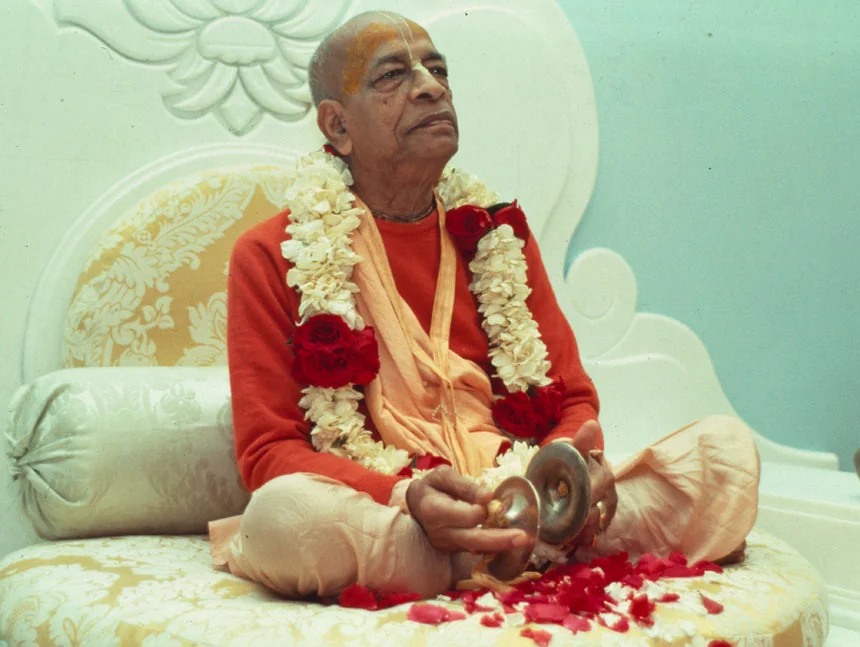
Evening Darsan

Absolute Truth Beyond Intellectual Interpretation, KC Spreads Worldwide Through Books

📅 May 11, 1977 📍 Rishikesh ⏱ 63 min
Understanding Krishna requires no intellectual gymnastics—direct surrender and devotion, not speculation or false interpretation.
Listen — Srila Prabhupada Uvaca

Transcript Preview

Prabhupāda: [Transl. The knowledge of the sat aspect of the absolute truth is Brahman realization. That is eternity. If you go further then you realize the Paramātmā aspect of the absolute truth. And the full knowledge of the absolute truth is the knowledge of Bhagavān.] Indian man: Full realization. Prabhupāda: Full realization. Tattva-darśina, one who knows what is what. What is Brahman, what is Paramātmā, and who is Bhagavān. You have to go to such a person.

That is Guru. jñāninas tattva-darśina [Bg 4.34] [Transl. What is the use of going to a vagabond? There will be no benefit. May be some partial realization.] Kṛṣṇa recommends tattvadarśī.

[Transl. And this tattva he understands. kaścin māṁ vetti tattvataḥ. manuṣyāṇāṁ sahasreṣu kaścid yatati siddhaye yatatām api siddhānāṁ kaścin māṁ vetti tattvataḥ [Bg 7.3] [Trans_A person who has attained perfection, out of many such persons, kascit or one may understand the Supreme Lord in truth. That means to understand the Supreme Personality of Godhead is not easy. He must be a tattvadarśī or self-realised. He is Guru. All of us can become tattvadarśī, because the absolute truth Himself descends and teaches us "I am like this." But we want to overrule Him. The Supreme Lord further declares; bhaktyā mām abhijānāti yāvān yaś cāsmi tattvataḥ [Bg 18.55] [Trans_That is possible only by bhakti or devotional service. Not by jñāna, karma or yoga. bhaktyā mām abhijānāti. Therefore the Lord tells us to become devotee. man-manā bhava mad-bhakto [Bg 18.65] [Trans_He didn't say bhava mad jñānī. So these are the conclusions. There is not much difficulty in realizing the absolute truth. The absolute truth personally comes and says, mattaḥ parataraṁ nānyat kiñcid asti dhanañjaya [Bg 7.7] [Transl. Just accept it that there is nobody greater than the Supreme Personality of Godhead Kṛṣṇa. But we will not accept Him. We will argue "Why Kṛṣṇa alone is the Supreme Lord? There are other Supreme Lords. This is God, that is God, I am God, you are God. Why are you searching after God? God is wandering about everywhere." Like that. Daridra-Nārāyaṇa, Nārāyaṇa has become poor! Serve Him! This is going on. yata mata tata patha or as many opinions as many ways. Simply manufacture a way and that is all right. Then how to find a Guru? The Lord says jñāninas tattva-darśina. People are giving up these conclusions.] Indian man: Why He has made it so difficult to realize Him? Prabhupāda: Han? We have made it difficult. Purposefully. [Transl. If someone asks you "Where is your nose?" You show him directly "Here it is." That's all. What is the need of showing the nose by encircling your hand around the head? What is the use of showing such foolishness like an ass? Encircling, that too can't reach. Show like this. Finished. You ask a boy and he will show you straight. But these people will show the other way. You make it difficult. Otherwise there is no difficulty. It's very easy. man-manā bhava mad-bhakto mad-yājī māṁ namaskuru [Bg 18.65]. Is it a difficult task? But they won't do it. Someone asked a teacher, "Sir, what is the meaning of the word 'vyāghra' or tiger? [aside: Please come. The teacher replied "Vyāghra means śārdula," a more difficult word. The Supreme Lord has explained Himself what is the absolute truth. "There is no truth superior to Me." So tell everybody that Kṛṣṇa is the Supreme absolute truth.] kṛṣṇas tu bhagavān svayam [SB 1.3.28] [Transl. Why don't they admit? The scriptures declare and the Acāryas accept it. Vyāsadeva accepts, Nārada accepts, Caitanya Mahāprabhu accepts, but we will not accept it. This is our misfortune. mahājano yena gataḥ sa panthāḥ [Mahābhārata, Vana-pārva 313.117(1)] Whatever the Mahājanas or the exalted personalities have said should be accepted. So to know the absolute truth is not difficult. The Supreme Personality of Godhead personally comes and says, svayaṁ caiva bravīṣi me. [Bg 10.13] This is what Arjuna said paraṁ brahma paraṁ dhāma pavitraṁ paramaṁ bhavān puruṣaṁ śāśvataṁ divyam ādi-devam ajaṁ vibhum āhus tvām ṛṣayaḥ sarve devarṣir nāradas tathā asito devalo vyāsaḥ svayaṁ caiva bravīṣi me [Bg 10.12-13] [Transl. You are the Supreme Personality of Godhead. It is not that because You are my friend, I am flattering You. No. Vyāsa, Nārada, big, big sages and Acāryas accept it. And You Yourself are saying this. svayaṁ caiva bravīṣi me [Bg 10.13] sarvam etad ṛtaṁ manye [Bg 10.14] [Transl. That's all. Finished. What is the difficulty of understanding the absolute truth? Not that I will take out this portion and that portion and present it. That is ardha-kukuṭi-nyāya or the half-hen-logic. A person had a hen. She used to lay an egg everyday. So he thought that my business is to take the egg from the behind, so I keep her back portion. And the front portion is expensive to maintain because I have to feed. So he cut off her throat. She won't eat, then I don't have to spend anything. Like this, they trim and clip Bhagavad-gītā. That is called ardha-kukuṭi-nyāya. "That we will have to accept Kṛṣṇa" this portion they clip off. And yet they claim to understand the absolute truth. This is the position. Ardha-kukuṭi-nyāya. There is no benefit from doing this. You will neither get egg nor have the hen. But we are presenting Bhagavad-gītā as it is. There is no choppings and clippings in it. And we are getting the good results. You see. These are foreigners and belonging to another religion. Their forefathers, fourteen generations or more have never heard of Kṛṣṇa. Now they have become devotees. They have accepted sannyāsa or the renounced order of life. They are traveling all over the world and preaching. It is working simply because they are accepting Bhagavad-gītā as it is. We have got branches everywhere. South Africa, South America, Australia, Europe, America, Canada and many other places. We are selling so many books in all languages.] How many languages we have published our books? Tamāla Kṛṣṇa: Thirty-one languages. Prabhupāda: [Transl. Thirty languages. [aside: Please come.] Indian man: [whispers] Thirty languages! Prabhupāda: [Transl. Even in Chinese and Japanese we have published.] Tamāla Kṛṣṇa: Russian also. Indian man: That is the greatest service to the Humanity. Prabhupāda: Russian also. Indian man: I see. Prabhupāda: [Transl. They like it. We receive order from Russia. We receive order from Russia for English books. From Germany. Now Germany is in Russia's control. They also order books for their Universities.] They are all appreciating Śrīmad-Bhāgavatam, Bhagavad-gītā, Śrī Caitanya-caritāmṛta. Just show Śrīmad-Bhāgavatam. Gopāla Kṛṣṇa: Prabhupāda has translated about eighty-four books. Indian man: Gitā? Gopāla Kṛṣṇa: Śrīmad-Bhāgavatam, till now about thirty volumes have been printed. Prabhupāda: We are finishing Śrīmad-Bhāgavatam in sixty volumes. Gopāla Kṛṣṇa: [Transl. See these paintings, these are done by Gurujī's disciples.] Prabhupāda: What is that? Indian devotee: Śrī Caitanya-caritāmṛta. Gopāla Kṛṣṇa: [Transl. Look, these are Sanskrit. Each word of each śloka is translated into English.] Indian man: Then there is translation of each verse in English and purport. Gopāla Kṛṣṇa: Yes. Each word, each word is explained. So there is no room for any interpretation. Prabhupāda: We have not brought the catalog? Tamala Kṛṣṇa: We have some…. Prabhupāda: Han? Tamāla Kṛṣṇa: I don't think so. Prabhupāda: Then ask him to send. Tamāla Kṛṣṇa: Gopāla? Prabhupāda: Yes. Tamāla Kṛṣṇa: [to Gopāla Kṛṣṇa: Need catalogs. Prabhupāda: Send catalog. Gopāla Kṛṣṇa: We don't have any at all here? Prabhupāda: Our books are being appreciated by all the big, big scholars of the world. Indian man: Depiction of the Indian art in these pictures is the most beautiful. Prabhupāda: Hān? Indian man: The Indian art depicted in these pictures is beautiful. Prabhupāda: Yes. For general public the picture is very attractive. Indian man: Each version costs fifty rupees. Literature is highest. It is not within the reach of general public. Gopāla Kṛṣṇa: [Transl. No, in Hindi they are cheap. Fifteen rupees each.] Prabhupāda: [Transl. They are the artists. American.] Indian man: Beg a pardon? Prabhupāda: This artistic work has been done by the Americans. Indian man: Yes. Yes. Prabhupāda: [Transl. I gave them the ideas and they painted it.] They are very intelligent. Indian man: [Transl. For us the situation is going reverse.] Prabhupāda: Hān? Indian man: [Transl. The young generation in India,] they are going away from this path. Prabhupāda: Yes. Because the leaders are rascals, what can be done? andhā yathāndhair upanīyamānās te 'pīśa-tantryām uru-dāmni baddhāḥ [SB 7.5.31] śva-viḍ-varāhoṣṭra-kharaiḥ saṁstutaḥ puruṣaḥ paśuḥ [SB 2.3.19] [Transl. There is an animal in the jungle. Lion. The other smaller animals have made it the king. Because the lion has become the king, does it mean it is no longer an animal? It is still an animal. Nowadays voting system, śva-viḍ-varāhoṣṭra-kharaiḥ saṁstutaḥ puruṣaḥ paśuḥ. Now we elect a leader. Who is he? He is a big animal. That's all. Nothing else. We are small animals and we vote a bigger animal. We are used for votting.] Indian man: [Transl. By your preaching and spreading of this culture in the west, the atmosphere here is gradually returning to normalcy.] Prabhupāda: [Transl. That's why I went there. Indian government… I tried to start here, but it didn't happen.] Indian man: [Transl. Our tendency has become like] you look to that side. Now roundwise we see that those people are coming to this. Prabhupāda: [Transl. Now difficulty is there, still they are accepting. The same old, dog's tail. No matter how much ghee you apply, it will remain bent only.] Indian man: [Transl. But something to be done for here also Mahārāja.] Prabhupāda: [Transl. You come forward and do. We are ready. You accept kṛṣṇas tu bhagavān svayam [SB 1.3.28] and preach. You are bringing thousands of Bhagavāns. I am Bhagavān. You are Bhagavan. Bhagavāns are in the street.] Indian man: [Transl. Bhagavān is one only.] Prabhupāda: [Transl. They don't know the meaning of Bhagavān. aiśvaryasya samagrasya vīryasya yaśasaḥ śriyaḥ jñāna-vairāgyayoś caiva ṣaṇṇāṁ bhaga itīṅganā [Viṣṇu Purāṇa 6.5.74(2)] [Transl. Bhagavān, the Supreme Personality of Godhead, is thus defined by Parāśara Muni as one who is full in six opulences, who has full strength, fame, wealth, knowledge, beauty, and renunciation. The condition is very pathetic. Anyway no problem. Whatever has happened has happened. Now we can rectify it if the messege of Bhagavad-gītā is propogated as it is. There is no difficulty. If it possible in the foreign countries where people follow different religion, it is possible in India also. This is punya-bhūmi or holy land. Therefore Caitanya Mahāprabhu says bhārata-bhūmite haila manuṣya janma yāra. It is not a cheap thing to get a human birth in Bhārat-bhūmi. It is attained by virtue of great piety. Even the demigods pray to the Supreme Lord that if we have any piety left, because when piety is exhausted we will have to go to the mortal world, so if any piety left kindly let us take birth in Bhārat-varṣa. That's a fact in Bhārat-varṣa. Therefore Caitanya Mahāprabhu says bhārata-bhūmite haila manuṣya janma yāra janma sārthaka kari' kara para-upakāra [Cc. Ādi 9.41] Make your life perfect by studying Bhagavad-gītā, and then after perfecting your life engage in Paropakāra or doing good to others. First of all you make your life successful.] [break] German man (1): Germany. Prabhupāda: Hmm? German man (1): Germany. Prabhupāda: Germany. English man (2): England. German man (1): In German. Prabhupāda: He is German. I went to Hamburg. German man (1): In Hamburg. In Batche Strasse? Bhakti-cāru: No. He went to Sromo[?] German man (1): [German] The very beginning center was in the Batche Strasse Street, a very small temple. And then it changed to bigger and..., in Hamburg. Prabhupāda: There is tramways. Bhakti-cāru: You are from Hamburg? German man (1): I was born in Hamburg. I left Phalia[?] four years ago and came here in Lakṣmaṇa-jhūlā. [conversation with German devotee] [break] Prabhupāda: ...here? Tamāla Kṛṣṇa: Why did you come to India? German man (1): For..., for spiritual purpose. Prabhupāda: Hmm? German man (1): Sādhana, tapasyā. Prabhupāda: And what is the aim of tapasyā? Tamāla Kṛṣṇa: What is the aim of tapasyā? German man (1): The aim of tapasyā? Tamāla Kṛṣṇa: The goal. German man (1): To see how is the one in the many. Tamāla Kṛṣṇa: To see the one in the many. Prabhupāda: Very good. And what is that one? Tamāla Kṛṣṇa: Prabhupāda asked, "What is that one?" German man (1): The one is this part in you and me which is together, and the many are you and me and him and we all. Prabhupāda: No, what is that one? German man (1): That one? It's difficult to put it into name. Tamāla Kṛṣṇa: He said, "It's difficult to put it into name." Prabhupāda: That means you have not found that one. German man (1): Probably. That is why I came to you. Prabhupāda: You could not find that one. Tamāla Kṛṣṇa: He said that's why he came to you. Prabhupāda: That is Kṛṣṇa. Ahaṁ sarvasya prabhavo mattaḥ sarvaṁ pravartate [Bg 10.8]. In the Bhagavad-gītā find out. Tamāla Kṛṣṇa: [aside:] Hand me the... Prabhupāda: If you cannot find it, hand it to Tamāla. Tamāla Kṛṣṇa: ahaṁ sarvasya prabhavo mattaḥ sarvaṁ pravartate iti matvā bhajante māṁ budhā bhāva-samanvitāḥ [Bg 10.8] "I am the source of all spiritual and material worlds. Everything emanates from Me. The wise, who know this perfectly, engage in My devotional service and worship Me with all their hearts." Prabhupāda: Hmm? Here is the one from whom everything emanates. So why don't you worship Him? Is there any purport? Tamāla Kṛṣṇa: Yes. Purport. "A learned scholar who has studied the Vedas perfectly and has information from authorities like Lord Caitanya and who knows how to apply these teachings can understand that Kṛṣṇa is the origin of everything in both the material and spiritual worlds. And because he knows this perfectly, he becomes firmly fixed in the devotional service of the Supreme Lord. He can never be deviated by any amount of nonsensical commentaries or by fools. All Vedic literature agrees that Kṛṣṇa is the source of Brahmā, Śiva and all other demigods. In the Atharva Veda it is said, yo brahmāṇaṁ vidadhāti pūrvaṁ yo vai vedāṁś ca gāpayati sma kṛṣṇaḥ: 'It was Kṛṣṇa who in the beginning instructed Brahmā in Vedic knowledge and who disseminated Vedic knowledge in the past.' Then again it is said, atha puruṣo ha vai nārāyaṇo 'kāmayata prajāḥ sṛjeyety upakramya: 'Then the Supreme Personality Nārāyaṇa desired to create living entities.' Again it is said, nārāyaṇād brahmā jāyate, nārāyaṇād prajāpatiḥ prajāyate, nārāyaṇād indro jāyate, nārāyaṇād aṣṭau vasavo jāyante, nārāyaṇād ekādaśa rudrā jāyante, nārāyaṇād dvādaśādityāḥ: 'From Nārāyaṇa, Brahmā is born, and from Nārāyaṇa, the patriarchs are also born. From Nārāyaṇa, Indra is born, from Nārāyaṇa the eight Vasus are born, from Nārāyaṇa the eleven Rudras are born, from Nārāyaṇa the twelve Ādityas are born.' It is said in the same Vedas, brahmaṇyo devakī-putraḥ: 'The son of Devakī, Kṛṣṇa, is the Supreme Personality.' Then it is said, eko vai nārāyaṇa āsīn na brahmā na īśāno nāpo nāgni-samau... [break] ...dyāv-āpṛthivī na nakṣatrāṇi na sūryaḥ sa ekākī na ramate tasya dhyānāntaḥ sthasya yatra chāndogaiḥ kriyamāṇāṣṭakādi-saṁjñakā stuti-stomaḥ stomam ucyate: 'In the beginning of the creation there was only the Supreme Personality Nārāyaṇa. There was no Brahmā, no Śiva, no fire, no moon, no stars in the sky, no sun. There was only Kṛṣṇa, who creates all and enjoys all.' In the many Purāṇas it is said that Lord Śiva was born from the highest, the Supreme Lord Kṛṣṇa, and the Vedas say that it is the Supreme Lord, the creator of Brahmā and Śiva, who is to be worshiped. In the Mokṣa-dharma Kṛṣṇa also says, prajāpatiṁ ca rudraṁ cāpy aham eva sṛjāmi vai tau hi māṁ na vijānīto mama māyā-vimohitau [Mokṣa-dharma, Mahābhārata] 'The patriarchs, Śiva and others are created by Me, though they do not know that they are created by Me because they are deluded by My illusory energy.' In the Varāha Purāṇa it is also said, nārāyaṇaḥ paro devas tasmāj jātaś caturmukhaḥ tasmād rudro 'bhavad devaḥ sa ca sarva-jñatāṁ gataḥ [Varāha Purāṇa] 'Nārāyaṇa is the Supreme Personality of Godhead, and from Him Brahmā was born, from whom Śiva was born.' Lord Kṛṣṇa is the source of all generations, and He is called the most efficient cause of everything. He says that 'Because everything is born of Me, I am the original source of it all. Everything is under Me. No one is above Me.' There is no supreme controller other than Kṛṣṇa. One who understands Kṛṣṇa in such a way from a bona fide spiritual master and from Vedic literature, who engages all his energy in Kṛṣṇa consciousness, becomes a truly learned man. In comparison to him, all others, who do not know Kṛṣṇa properly, are but fools. Only a fool would consider Kṛṣṇa to be an ordinary man. A Kṛṣṇa conscious person should not be bewildered by fools. He should avoid all unauthorized commentaries and interpretations on Bhagavad-gītā and proceed in Kṛṣṇa consciousness with determination and firmness." Prabhupāda: So here is the one. You don't accept? You are finding out the one. So where is? So here is the one. Aham ādir hi devānāṁ [Bg 10.2], mattaḥ sarvaṁ pravartate iti matvā bhajante māṁ budhā bhāva... Hmm? You have got objection to accept Kṛṣṇa the supreme one? Tamāla Kṛṣṇa: "What is your answer?" Prabhupāda asks. Prabhupāda: Why don't you accept Him? In Vedic evidences He is the Supreme. [aside:] Please come. Indian man (4): Swāmījī, Christ says that he's the goal. Prabhupāda: Hmm? Indian man (4): Christ says that he's the Almighty. What is your opinion? Tamāla Kṛṣṇa: He said, "Christ says that he is the Almighty. What is your opinion?" Prabhupāda: Where he said? Indian man (4): In Bible said. "I am the God, come." Prabhupāda: He said? Tamāla Kṛṣṇa: No, he never says that. Trivikrama: "I am the son of God." Tamāla Kṛṣṇa: He said, "My father, who art in heaven, hallowed by Thy name. Thy kingdom come, Thy will be done." He never says, "My kingdom come, my will be done." Trivikrama: Says "I sit at the right hand of God." German man (1): "The Father and me are one," he said. To people he said, the father in the heaven, and to his disciple he said, "The Father is in me. The Father is in me. I am one with the Father. I am not real, but the Father in me, He is doing everything. I am doing nothing." Every truth... Somebody touch his feet, he said don't touch. "Don't tell me, my Father and me," he said. Devotee (5): We chant every morning, sākṣād-dharitvena... Prabhupāda: No bona fide person will say that "I am God." As soon as one says that "I am God," he's a rascal immediately. God is not so cheap. Caitanya Mahāprabhu never said. He said, "I am servant of the servant of the servant of servant of." Gopī-bhartuḥ pada-kamalayor dāsa-dāsa-dāsānudāsaḥ [Cc Madhya 13.80]. Hundred times down. And that is real identification. And as soon as a person says, "I am God," then he's a madman. He's part of God. That is all right. But not the Supreme God. Indian man (4): Can we find the one in ourself? Can we find the one in the basis of ourself? Prabhupāda: Hmm? Indian man (4): The one in the basis of ourself? Tamāla Kṛṣṇa: He says, "Can we find the one in ourselves?" Prabhupāda: Yes. The Self is there. Īśvaraḥ sarva-bhūtānāṁ hṛd-deśe 'rjuna tiṣṭhati [Bg 18.61]. That one Lord is there within your heart. Where is the difficulty? That is stated in the Bhagavad-gītā. Īśvaraḥ sarva-bhūtānām. All living entities—not only you, me—cats, dogs, everyone, even ants... Aṇḍāntara-stha-paramāṇu-cayāntara-stham. He is within the atom also. So there is no denying. He is everywhere. eko 'py asau racayituṁ jagad-aṇḍa-koṭiṁ yac-chaktir asti jagad-aṇḍa-cayā yad-antaḥ aṇḍāntara-stha-paramāṇu-cayāntara-sthaṁ govindam ādi-puruṣaṁ tam ahaṁ bhajāmi [Bs 5.35] So Īśvara, this, the Supreme, is living with you as Supersoul. So there is no doubt about it. You are also within the body, and He is also within the body. Find out this verse, kṣetra-jñaṁ cāpi māṁ viddhi sarva-kṣetreṣu bhārata, kṣetra-kṣetrajñayor jñānam [Bg 13.3]. You are individual soul, and He is also living as individual soul, but sarva-kṣetreṣu: He is living everywhere; you are living within your body. That is the difference. Indian man (4): Then one can realize the omnipresence of the one. Tamāla Kṛṣṇa: "How can we realize the omnipresence?" Prabhupāda: You have to realize from authorized scripture, not whimsically. Just like this boy asked, "God, Christ said like that," without any authority. Without reading, without understanding, he says like that. So you have to take from authority. Without authorized statement don't say anything. It is foolish. Śabda-pramāṇam. Just like a good lawyer in the court. When he says something, immediately he quotes the law, "Section number such, laws number such," and that is authorized; not that whimsically if he says. That is not the process. [aside:] You have found out? Kṣetra-jñaṁ cāpi māṁ viddhi sarva-kṣetreṣu... Thirteenth Chapter. Tamāla Kṛṣṇa: Ah. kṣetra-jñaṁ cāpi māṁ viddhi sarva-kṣetreṣu bhārata kṣetra-kṣetrajñayor jñānaṁ yat taj jñānaṁ mataṁ mama [Bg 13.3] Prabhupāda: And before that? Tamāla Kṛṣṇa: Kṣetram ity abhidhīyate... Oh. Prabhupāda: Idaṁ śarīraṁ kaunteya. Tamāla Kṛṣṇa: idaṁ śarīraṁ kaunteya kṣetram ity abhidhīyate etad yo vetti taṁ prāhuḥ kṣetra-jña iti tad-vidaḥ [Bg 13.2] "Arjuna said, O my dear Kṛṣṇa, I wish to know about prakṛti, puruṣa, and the field and the knower of the field, and of knowledge and the end of knowledge. The Blessed Lord then said, This body, O son of Kuntī, is called the field, and one who knows this body is called the knower of the field." Prabhupāda: Just like every one of us. I know, you know, that "This is my body," "This is my finger," "This is my leg." So the body is called kṣetra. We have been allotted a kṣetra. Just like the government distributes the land to a certain person, that "This is your land. You till it and grow your food," thirty bighās or something like that. This body is like that. Īśvaraḥ sarva-bhūtānāṁ hṛd-deśe arjuna tiṣṭhati [Bg 18.61]. He is there within the body, and He is giving us this kṣetra. Bhrāmayan sarva-bhūtāni yantrārūḍhāni māyayā. So I have got this body. You have got that body. The dog has got body. The cat has got body. So He's everywhere. So according to his karma or desire, he gets a body. Īśvaraḥ sarva-bhūtānām [Bg 18.61]. And he works. Therefore the body is the kṣetra, the field, and the individual soul is the worker. So he is working and getting the fruitive result, but at the same time, God is also with him. But He is everywhere. I am not everywhere. I am one individual. Do you understand? And that is the difference between God and me. I cannot say what you are now thinking now, or you cannot say what I am thinking. But God knows what you are thinking and what I am thinking, what he is thinking. That is the difference. That is explained. Kṣetra-jñaṁ cāpi mām. He is also within the body, but that is the difference between Him and you. You are limited within your body, and He is unlimited. He is everywhere. So how you can become God? Therefore one who says, "I am God," he's a fool. You cannot say what I am thinking now or what I am suffering. You cannot prove. But He can feel your suffering and feeling, and that is the difference. Here it is clearly said, kṣetra-jñaṁ ca. Ca means "also." "Also" means "I am there." Not one; two. Kṣetra-jñaṁ ca api māṁ viddhi. So God knows what I want, and according to my desire, He is giving me certain type of body—not directly, but through His energy, material nature. Bhrāmayan sarva-bhūtāni yantrārūḍhāni māyayā [Bg 18.61]. He has got so many agents. Parāsya śaktir vividhaiva śrūyate [Śvetāśvatara Upaniṣad 6.8(3)]. So this material nature is also one of the agents. And He knows what I desire. He's very friendly, that "This living entity wants this, so give him a body like this." So we get a body. Tathā dehāntara-prāptir dhīras tatra na muhyati [Bg 2.13]. So we have to change the body according to our desire. If we want to go to the higher planetary system, we can go. God will give us the facility. If you want to go to the lower planetary system, He'll give you. And if you want to go to Him, He'll give you. What is that verse? Yānti deva-vratā devān pitèn yānti pitṛ-vratāḥ... [Bg 9.25]. Tamāla Kṛṣṇa: Bhūtāni yānti bhūtejyā... Prabhupāda: ...mad-yājino 'pi yānti mām. If you want to go the devas, you can go. If you want to remain here, you can remain here. If you want to go back to home, back to Godhead, you can go. All facilities are there. But don't lunatically say that "I am God. I am everything." Don't be. Jīva is part and parcel of God, but part and parcel means the same quality but not the same person. This finger is part and parcel of my body. If you cut this finger you will find the same blood. And if you cut here, the same blood. But the finger is not the whole body. The finger is finger; your body is body. The quality is the same. So if you thoroughly study the nature of the living being, you can have at least idea of what is God. Janmādy asya yataḥ [SB 1.1.1]. The Vedānta-sūtra says. Whatever desires I have got, wherefrom these desires come? It comes from God, because I am part and parcel of God. So the janmādy asya yataḥ. I am born a person, so God must be a person. That is natural. A person is born from a person. [break] Why this obstinacy? Say me. Tamāla Kṛṣṇa: What is your reply? Prabhupāda wants you to reply to him. German man: Reply what? Prabhupāda: You are searching after that one who has become many. German man (1): I don't say. I don't search after that one? Prabhupāda: You said that you are searching after that one. German man (1): I search...? Prabhupāda: Yes. German man (1): No. Prabhupāda: You told me. You did not? Tamāla Kṛṣṇa: You said that you were searching or looking for the one in many. German man (1): Ācchā. Yes, I looked the one in many. Yes, I saw it, the one in many. Tamāla Kṛṣṇa: You saw it. German man (1): If I see, I'll be able to see the one... Prabhupāda: Yes. German man (1): ...in many. Not to thought, but to search. I said to see. Prabhupāda: Here you can see. Why don't you see Kṛṣṇa? German man (1): Huh? Prabhupāda: Why don't you see Kṛṣṇa? German man (1): But I see Him. Prabhupāda: Then that is the one. You are looking after that one. So that He is. That is explained. Ahaṁ sarvasya prabhavaḥ [Bg 10.8]. German man (1): Sometimes I feel as Arjuna. Prabhupāda: No, you feel, that is another thing. You can feel so many things. That is not authorized. But if you are searching after that one, here is the one. That is accepted by the all authorities and ācāryas. And He showed His viśva-rūpa, virāḍ-rūpa, that everything is there. Practically Arjuna was shown the virāḍ-rūpa. So why don't you accept Him? What is your objection? German man (1): I have no objection. Prabhupāda: Then why don't you accept? Tamāla Kṛṣṇa: Then why don't you accept? German man (1): I accept. Right when I got into Gītā, I start to read it and I start to follow, I tried to follow. Prabhupāda: That's nice. German man (1): I accepted completely. Prabhupāda: Then it is all right. German man (1): I have no more hesitation about this. Prabhupāda: So we are preaching that "Here is God: Kṛṣṇa." Our preaching is simple. Kṛṣṇa says, "I am the Supreme." We say, "Kṛṣṇa is the Supreme." That's all. We repeat. We don't manufacture. What is the use of manufacturing? I am imperfect. Whatever I manufacture, that is imperfect. So better to repeat the words of the perfect. That is Caitanya Mahāprabhu's mission. He said, "Every one of you become guru and deliver your surrounding persons, either you are in family or in a neighborhood or in a society or in a nation—as much as you can." Āmāra ājñāya guru hañā tāra' ei deśa [Cc Madhya 7.128]. So whatever limited circle, you just become guru and deliver them. Deliver means deliver from the ignorance. Everyone is in ignorance, dehātma-buddhiḥ. Yasyātma-buddhiḥ kuṇape tri-dhātuke, sa eva go-kharaḥ [Bg 3.40, purport]. So we have to teach them that "You are not this body. You are pure soul. Your business is different." And that is enlightenment. That is business of guru. So we can do that business. And how to do it? That is... Caitanya Mahāprabhu says, yāre dekha tāre kaha kṛṣṇa-upadeśa [Cc Madhya 7.128]. You haven't got to manufacture anything. What Kṛṣṇa has already said, you repeat. Finish. Don't make addition, alteration. Then you become guru. Very simple thing. If I say that "My father said, 'This is a bell,' " I am correct because I have learned it from my father, authority. I may be fool, rascal; it doesn't matter. But because I have learned it from the authority and presenting it that "This is a bell," this is perfect. Similarly, I cannot become guru because I am imperfect. My senses are imperfect. I cannot see what is beyond this wall, although I am very much proud of my eyes. I want to see. What you can see? Imperfect, all senses. But if some authority says that "Beyond this wall this is the..., like this," it is all right. So we have to follow this path, that you become guru, deliver your neighborhood men, associates, but speak the authoritative words of Kṛṣṇa. Then it will act. So our this Kṛṣṇa consciousness movement is like that. We do not manufacture ideas. That has spoiled the whole world. Just like you said about Christ. That he never said "Supreme Lord." He said, "I am son of God. I have brought message from Him." Similarly, our position is that "We have got a message from Kṛṣṇa. Take it." So we have no difficulty. Anyone can say. If we study Bhagavad-gītā nicely, assimilate and repeat it, it will act. Kṛṣṇa says, man-manā bhava mad-bhakto mad-yājī māṁ namaskuru [Bg 18.65]. We are teaching that "You always think of Kṛṣṇa. You become a devotee. You worship Him and offer your obeisances." It doesn't require to become very learned scholar. Anyone can do it. A child can do it. We are teaching. Where is the difficulty? Hmm? Is there any difficulty? Why don't you do that? Why you are making so big, big program without any effect? Take the simple program, and preach everywhere. That is being done. We are preaching this philosophy all over the world, and they are accepting. You know that. In Europe, America, Australia, Canada—in all parts of the world they are appreciating. Even the Africans, they are chanting, dancing. So if I have manufactured some theory and with a limited circle I am satisfied, that is good? Or Kṛṣṇa's program, Caitanya Mahāprabhu's program, which is being accepted all over the world—that is good or this is good? Which one is good? So everyone is manufacturing some concoction, and he's satisfied with few followers. But we have got Kṛṣṇa's program, and it is being followed all over the world. So which one is good: with some limited circle or all over the world? There is a proof. We are not theoretical. German man (1): Is Kṛṣṇa's vision what He liked? Prabhupāda: Hmm? German man (1): Is Kṛṣṇa's own vision what He liked? Tamāla Kṛṣṇa: What is your vision? German man (1): I don't know. [indistinct—very faint audio] Tamāla Kṛṣṇa: He says... It's hard to understand what he's getting at. He says, "It's Kṛṣṇa's vision, He..." German man (1): [indistinct] circle or a limited circle? Prabhupāda: Anything... German man (1): Or Kṛṣṇa consciousness is all over the world? It is His own vision, or Kṛṣṇa's own vision, what He wants to do is this? Prabhupāda: Yes. That is Kṛṣṇa consciousness. German man (1): So if He creates a circle, maybe a small cirlce, as He creates consciousness all over the world. It's His consciousness. Prabhupāda: Yes. That is Kṛṣṇa consciousness. Now all over the world they are chanting Hare Kṛṣṇa. That's a fact. German man (1): What is happening [indistinct]. One soul has to come back to this earth. Tamāla Kṛṣṇa: He says a great devotee has to come to this earth and make this mission spread all over the world. Prabhupāda: Yes. Without Kṛṣṇa's authorized person, nobody can do it. Kṛṣṇa-śakti vinā nāhi nāma-pracāra [Cc Antya 7.11]. Without being empowered by Kṛṣṇa, nobody can do it. German man: You have surrendered completely? Prabhupāda: Yes I do that. That is the real work. I know my Guru Mahārāja. He said that you do throughout the world. So I am trying to serve him. [indistinct] German man (1): [indistinct] Prabhupāda: There is another statement by Caitanya Mahāprabhu about Kṛṣṇa consciousness: yei bhaje sei baḍa, abhakta—hīna chāra kṛṣṇa-bhajane nāhi jāti-kulādi-vicāra [Cc Antya 4.67]. Anyone who is a devotee of Kṛṣṇa, he is considered highly qualified, sei bhakta. He is not ordinary. Abhakta hīna chāra. But one who is not devotee of Kṛṣṇa, he is condemned. Then, is there any particular nation or creed who can take it? No. Kṛṣṇa bhajana nāhi jāti-kulādi. If one wants to take to Kṛṣṇa, there is no condition behind that he should belong to such and such country, such and such religion. Anyone can do it. Māṁ hi pārtha vyapāśritya ye 'pi syuḥ pāpa-yonayaḥ [Bg 9.32]. It doesn't matter. We discriminate mlecchas, yavanas. But Kṛṣṇa doesn't. Kṛṣṇa says ye 'pi syuḥ pāpa-yonayaḥ striyo vaiśyās tathā śūdrās te 'pi yānti parāṁ gatim [Bg 9.32] There is no restriction. You can practically see them. Before that they were all mlecchas, yavanas, and now they are vaisnavas. [aside: Please come. yei bhaje sei bada. [break] [end] Endnotes 1 (Popup - Popup) ’Dry arguments are inconclusive. A great personality whose opinion does not differ from others is not considered a great sage. Simply by studying the Vedas, which are variegated, one cannot come to the right path by which religious principles are understood. The solid truth of religious principles is hidden in the heart of an unadulterated, self-realized person. Consequently, as the śāstras confirm, one should accept whatever progressive path the mahājanas advocate.’ Mahābhārata, Vana-pārva 313.117 2 (Popup - Popup) Full wealth, strength, fame, beauty, knowledge and renunciation—these are the six opulences of the Supreme Personality of Godhead. Viṣṇu Purāṇa 6.5.74 3 (Popup - Popup) The Supreme Lord has nothing to do. Nothing is equal to Him or greater than Him. He acts in different phases by manifesting His parts and parcels, which are all simultaneously differently situated by His unlimited, variegated potencies. Each potency acts quite naturally in sequences, providing Him full knowledge, power and pastimes. Śvetāśvatara Upaniṣad 6.8

BhaktiSpiritual MasterKnowledgeKrishna ConsciousnessGuruSurrender
← All Srila Prabhupada lectures