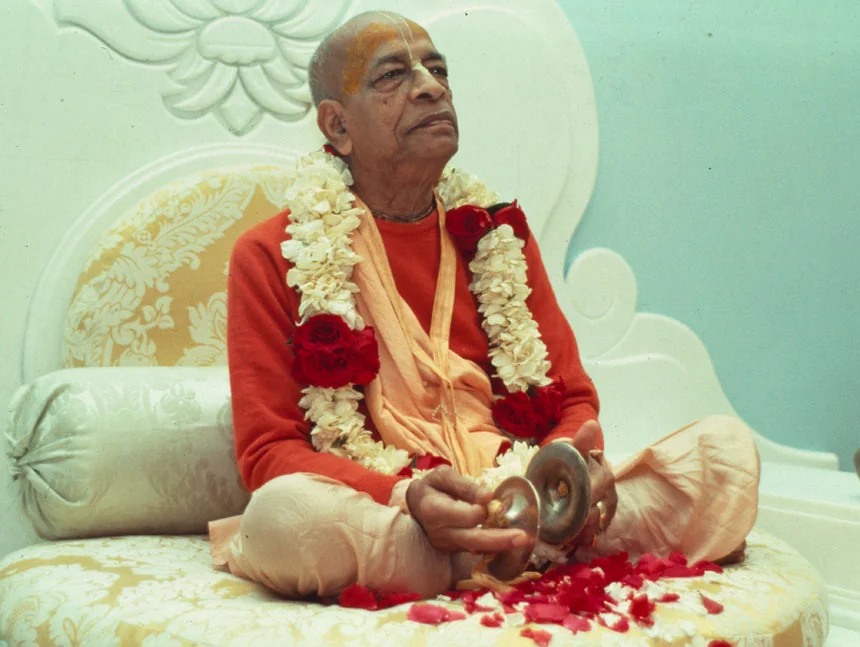
Room Conversation

Pure Intelligence Accepts Supreme Creator, Following Mahajanas Over Foolish Speculation

📅 January 20, 1977 📍 Bhubaneswar ⏱ 47 min
Follow the mahajanas' proven path of surrender rather than futile intellectual speculation; chant Krishna's names.
Listen — Srila Prabhupada Uvaca

Transcript Preview

[Gour Govinda preaching in temple in Oriya over loudspeaker in background] Prabhupāda: ...neither they do not know how life becomes possible. They may go on "Bak, bak," but these two things are absent. You are all scientist? No.

You do not know how life becomes possible. They simply theorize in so many ways, but they cannot give us any positive information. Indian man: [Transl. How to develop strong faith that God does exist? We don't always understand in spite of thinking in so many ways.] Prabhupāda: [Transl. Simply by purifying the intelligence it will be done. If the intelligence is polluted there will be no gain. We have to think like a human being. Then it is possible. If you follow the scriptural injunctions with faith…What is the reason? There must be a creator. Everything has a creator. Just like this table, somebody has made it. Somebody made this table. Similarly who has created this whole universe? Someone must have done it. How can you deny it? What is the cause? Answer?] Indian man: [Transl. There is no question of denying.] Prabhupāda: [Transl. Then? Just accept it, that's all. So if your intelligence is pure then you will accept. If the intelligence is lost then there is no use. Those foolish persons who are saying "Everything happened by chance," they are foolish. What on earth came by chance? Fools. Great fools. If we accept the words of the great fools we will gain nothing. What do you say? Is everything happening by chance?] Indian man: [Transl. It's difficult. In India, it is difficult. There are so many śāstras and Bhagavad-gītā. But we are…] Prabhupāda: [Transl. In our country there are so many śāstras and so much knowledge. Vedas, Vedānta, Purāṇas, Bhagavad-gītā, and these literatures are being respectfully accepted all over the world. Without caring for all that you are foolishly declaring "Everything is happening of its own." That's all. So long you hear the foolish words there is no benefit. So first of all you will have to set your mind that we are not going to listen to the words of the fools. Only then you will understand. Those who preach "Everything is happening by chance," are they foolish or not?] Indian man: [Transl. That's true.] Prabhupāda: [Transl. Then? What is the use of the statements by the fools? If we firmly make up our mind that we won't hear the words of the fools then things will improve. Everything is explained in the śāstras. The Supreme Personality of Godhead Kṛṣṇa Himself is coming and explaining what is the truth. Then His representatives are also explaining. All the big, big sages, Vyāsadeva, Nārada, Asita, then big, big Ācāryas-Rāmānujācārya, Madhvācārya, Saṅkarācārya and so on, then recently Caitanya Mahāprabhu, they all are preaching the real truth. What is the use of listening to the words of some foolish people by ignoring such personalities? What is their consideration? Hear their words and everything will be alright. By hearing the words of the foolish people, foolish snarling dogs, nothing will be gained. Now the whole world is filled with fools.] Indian man: [Transl. Means?]

Prabhupāda: [Transl. It means they are passing of as learned by disregarding the sādhus, sannyāsīs, gurus and so on, but actually they are number one foolish. They don't know anything. You name it and we will prove each of them is foolish. Bring anyone, scholars, sādhus, sannyāsīs, politicians and so forth. All are foolish people. Why foolish? Bring each and every one of them, and we will prove you why they are foolish. You choose who to pick make analysis? That's why we have accepted only one thing which is right—Bhagavad-gītā As It Is. Whatever the Supreme Personality of Godhead says that's right. That's all. And it is producing result. Just see all these big, big scholars, they are accepting it. The people of the entire world are gladly accepting.] Indian man: [Transl. In which form do we have to meditate on God? His…] Prabhupāda: [Transl. God Himself is coming and canvassing. Ahaṁ sarvasya prabhava [Bg 10.8]. [Transl. This much you can understand I believe. Kṛṣṇa Himself is declaring "I have created everything. Ahaṁ sarvasya prabhava." Then why are you asking this again? Don't you read Bhagavad-gītā?] Indian man: [Transl. Little bit.] Prabhupāda: [Transl. Why little? Read little more. All answers are there. There is someone who has created all this. He said, ahaṁ sarvasya prabhava. And the person who heard Him, Arjuna, accepted it. Vyāsadeva accepted it, Nārada accepted it, big, big ācāryas accepted it and why you are in doubt?] Mahājano yena gataḥ sa panthāḥ [Cc Madhya 17.186]. [Transl. We should follow the path traversed by the Mahājanas or great personalities. Then why are you not following this? What is the reason? Are you more learned and more intelligent than them? All the big, big ācāryas have accepted it, and you are not following them. So does that mean you are more learned than them?] Indian man: [Transl. Not like that…] Prabhupāda: [Transl. Then why are you not accepting it?] Indian man: [Transl. To perceive Him with my senses…] Prabhupāda: [Transl. What senses? He is beyond your senses. Therefore it is said, mahājano yena gataḥ sa panthāḥ. A small boy doesn't know anything. Whatever his father says he simply does it. That's his duty. When the father is instructing, "Dear son, do like this. It will be good." Then why noy accept it? He is definitely beyond the sense perception, but the person who has perceived Him, is explaining that you do like this. Why don't you accept that? Why do you willingly want to remain a fool? That is the point. All the ācāryas are accepting. Big, big ācāryas who have protected our culture, ācāryopāsanam. [Bg 13.8] We have to follow the path chalked out by the ācāryas. Those who are authorised ācāryas. And the greatest ācārya is Kṛṣṇa. Ācāryaṁ māṁ vijānīyān. [SB 11.17.27] [Transl. The real acarya is Kṛṣṇa. And those who are repeating His words, they are also ācārya. That's all. Just like we are acting as Guru, does it mean we are inventing new rules? Whatever the Supreme Lord has said, we simply repeat. "Look, the Supreme Lord says,] Mattaḥ parataraṁ nānyat [Bg 7.7]. [Transl. This Kṛṣṇa is the Supreme Personality of Godhead. Nobody is greater than Him. This is our preaching. Just accept it. What else do we preach? You see these books are being greatly appreciated in America and Europe. What else do we say? Whatever the Supreme Lord has said, we just repeat. Are we manufacturing something new? The śāstra says, kṛṣṇas tu bhagavān svayam [SB 1.3.28] And we say Kṛṣṇa is the Supreme Personality of Godhead. They are accepting it. That's all. Your senses are not perfect. Everyone knows it. But why don't you accept the words of that person whose senses are perfect? What is your answer? Speak?] Indian man: [Transl. We are used to immediate result. That's why we look for the quicker path.] Prabhupāda: [Transl. You are not adopting the right path for getting result. So how will you get the result? Had you adopted the path you would not have said that. You have a doubt. Hence you are asking how to fix the mind. The śāstra is explaining how to control the mind. "Do like this."] Man-manā bhava mad-bhakto mad-yājī māṁ [Bg 18.65]. [Transl. Why don't you take it? The question does not arise as to how to control the mind, because the Supreme Lord is prescribing, man-manā bhava mad-bhakto. Why are you not doing that? What is the difficulty in it? Answer? Your question is how to fix the mind. And the Supreme Lord Himself is telling, man-manā bhava mad-bhakto. Why don't you follow it? Why are you not doing it?] mayy āsakta-manāḥ pārtha yogaṁ yuñjan mad-āśrayaḥ asaṁśayaṁ samagraṁ māṁ yathā jñāsyasi tac chṛṇu [Bg 7.1] [Transl. The Lord is explaining Himself. What is the need of your mental speculation? Accept what He says and everything will be alright. If you disregard that and simply speculate, what will you gain? I am just answering your question. If you have any objection, tell me. Suppose you ask a gentleman, "I will go to Puri. So which way should I go?" And he replies "Go that way." Then you have to follow him. Otherwise there is no need of asking anything from anybody. Do whatever you like. So one should inquire from such a source whom he trusts. And then he has to follow what he says. Then it will be fruitful. If you don't believe him, then why do you waste your time and his time? Answer? You asked about how to control the mind. We don't manufacture and preach something. We simply repeat what the Supreme Lord has instructed. Just like the Supreme Lord says, man-manā bhava mad-bhakto mad-yajī māṁ namaskuru mām evaiṣyasi asamsaya. [Bg 18.65] [Transl. Why don't you follow this? Reply? What is the reason? You have to answer. What is the reason? Say all of you? Why are you not answering this? Speak? It is like, "We won't hear the real truth. We would rather hear foolish people and do things whimsically. Therefore we would perpetually remain fools and not be intelligent ever."] Andhā yathāndair upanīyamānā te 'pīśa-tantryām uru-dāmni baddhāḥ [SB 7.5.31] [Transl. Caitanya Mahāprabhu, Kṛṣṇa first came and taught us everything. Then Kṛṣṇa again came as a devotee and taught us. Still if you are unable to understand then it's our bad luck. Most unfortunate. That's a fact. The Supreme Lord is descending personally and revealing Himself, but we don't take His instructions. And the Supreme Lord is coming as a devotee, still we don't accept His instructions. That means our luck is down. What to expect from a bad luck. "These are useless. We will be alright." That means extremely unlucky. In Bengal there is a curse "Poḍā-kapāla or burnt luck." So why remain unfortunate?] "Man is the architect of his own fortune." So we can take the words of the ācāryas. Then everything is all right. [Transl. Try with this simple formula.] Harer nāma harer nāma harer nāmaiva kevalam kalau nāsty eva nāsty eva [Cc. Ādi 7.76]. [Transl. Adopt. There is no expenditure in this at all. Neither any loss. Why don't you do it? When you walk on the street, just chant Hare Kṛṣṇa, Hare Kṛṣṇa. These people are doing on beads, but we are not doing. Hare Kṛṣṇa Hare Kṛṣṇa, what is my loss in it? And if there is profit why not do it? Why don't you practice all this? If you chant the holy name of Hari, will anyone hang you? The śāstra is recommending this, harer nāma harer nāma harer nāmaiva kevalam. Why don't you do this? Will anyone put a noose around your neck because you are chanting the holy name of Hari? And what loss there is? Don't you see the gain? The mind will become peaceful. Everything will be all right.] Ceto-darpaṇa-mārjanam [Cc Antya 20.12]. [Transl. All misconceptions will vanquish. Tell me if you have got the answer of your question.] Indian man: [Transl. That means we have to take shelter of the holy name of Kṛṣṇa all the time.] Prabhupāda: [Transl. Take shelter means chant. Everything will be all right. Kīrtanīyaḥ sadā hariḥ. Tṛṇād api sunīcena This is Mahāprabhu's teaching. Taror api sahiṣṇunā, Suppose you are chanting the holy name of Kṛṣṇa and your friends, circle are criticizing you, but you have to tolerate it. Tṛṇād api sunīcena, taror api sahiṣṇunā. So you do that. This is Mahāprabhu's teaching.] tṛṇād api sunīcena taror api sahiṣṇunā /amāninā mānadena kīrtanīyaḥ sadā hariḥ [Cc Ādi 17.31]. Indian man: [Transl. We respect you so much. We learn from you. By your mercy it will happen. Hare Kṛṣṇa. Hare Kṛṣṇa.] [long pause, preaching going on over loudspeaker; lecture ends] Prabhupāda: [Transl. You are leaving? Do you have any question?] Indian man: [Transl. Prasāda?] Prabhupāda: [Transl. Okay. All of you take some prasāda.] Give them prasāda. [Guests leave] [Transl. Jaya. All of you go and take prasāda.] Indian boy: I want to read some books published by Swāmījī. Can I get? Prabhupāda: Yes, why not? You can have here. We have got forty standing orders from this city in different libraries, colleges. So you can take books from any library, or if you like you can purchase also. Indian boy: From libraries? Prabhupāda: Yes. So many libraries, they have ordered. There is a list in Orissa. [rings bell; aside:] You can give me little, little sample... [break] ...for life that it is a dead body. A dead body. So what is the use of decorating a dead body? So if anyone accepts Christ actually and his instruction, then it proves that he has got a good soul. Otherwise what... He's dead body. That's a fact. If one accepts that Christ said, "Thou shall not kill. Thou shall not do this," if one is actually a person with soul, they must accept this. Otherwise where is the use? Dead body. The same thing, as we say, aprāṇasya hi dehasya maṇḍanaṁ loka-rañjanam [Hari-bhakti-sudhodaya 3.11(1)]. What is the use of decorating a dead body? A dead body means soul-less. When the soul is not there, it is called dead body. So even one has got the soul, but he does not act..., they possesses the soul, then it is dead body. So when we shall hear about the land? One program is suspended. That program is for constructing a house for me. Gargamuni: Oh, in Māyāpur. Prabhupāda: Yes. I have suspended it. So first of all let us see how much land we are going. Then we shall select. Gargamuni: Well, I feel this land acquisition is not going to take place so soon, 'cause as... [break] Prabhupāda: Yes. Why should we think? Gargamuni: That has always been your program. Prabhupāda: Yes. Why should we think Kṛṣṇa is poor man? Gargamuni: You used to give us ISKCON bullets when we came. Prabhupāda: [laughs] Yes. You were from the very beginning. Alone, I was preparing. "Give them at least one or two chapātis. That's all." Gargamuni: You were keeping in the corner... Prabhupāda: [laughs] Yes! Gargamuni: ...in your apartment. We used to ask, "Swāmījī, can we take?" And you used to say "Yes." Prabhupāda: And that Stryadhīśa? Gargamuni: Yes, Stryadhīśa. He would eat twenty chapātis. Prabhupāda: "Stryadhīśa, shall I give you more?" "Yes. Four." Then he finished. "Shall I give you more?" "Yes." So I was giving him four at a time. So four at a time, I was giving five times, six times. [laughs] Gargamuni: Yes, so much. There was always a stock of something. Prabhupāda: That atta, one bag. Gargamuni: One bag a week. Prabhupāda: And Kīrtanānanda was preparing at a time at least ten chapātis in that oven, very quickly. Yes. And Jadurāṇī was rolling. Everyone was engaged. And on Saturday we prepared so many samosās, purīs and sweetballs, kept in stock, and Sunday people were coming. At least seventy-five guests. Gargamuni: Oh, yes. In that little room... Prabhupāda: Yes. Gargamuni: ...in 26 Second Avenue. Prabhupāda: Yes. Gargamuni: It was packed up. Prabhupāda: Acyutānanda's mother was coming. Sometimes your mother came? No. Gargamuni: Not for a feast, but she came. Prabhupāda: No, she used to come. And kissing you. [laughter] He's very pet son of his mother. Sometimes I told her, "Mrs. Bruce, you can give us some money." "I have given my two sons!" And "That's all right." Gargamuni: Angry. [laughs] Prabhupāda: I have met his mother. Is very nice lady. Rāmeśvara: My family is very much afraid that they may lose another son to this movement. [Prabhupāda laughs] They are very afraid of that. They know that this is so good. The books are so convincing. Prabhupāda: But I don't think your mother was any time angry upon me. Gargamuni: No. Prabhupāda: No. She liked at our... Gargamuni: She knows we're leading a good life. Rāmeśvara: We have one mother in Los Angeles of a girl named Līlā-śakti. She's a big book distributor. And her mother, she loves this movement so much that when the deprogrammers start debating us, she stands up and yells at them that "My daughter was on drugs, hippie, before she came to this movement. This movement has saved her. If I had known about this movement when I was a young girl, I would have joined this movement!" On television she's speaking like that, very strongly: "You have no right to criticize! You don't know anything about this movement." Gargamuni: Śravānanda's mother too. Rāmeśvara: She says, "You just come over to my house for lunch and I'll tell you all about this movement, how nice it is." She started this club, Parents for Kṛṣṇa. Prabhupāda: Oh, she is very sincere. And her daughter, this Līlā...? What is? Rāmeśvara: Līlā-śakti. Prabhupāda: She's wonderful girl. She's expert in everything. Hayagrīva's mother, father? Gargamuni: Yes. They wrote that letter. Prabhupāda: Yes. No, they personally came. And many fathers came to Los Angeles to give me thanks: "Swāmījī, it is our great fortune that you have come." They said like that. Gargamuni: Śrīla Prabhupāda, there's also another program which I think requires some financial assistance, is this boat program. In one month they sold ten thousand books, a group of ten men. And they go to so many villages. And I think if we can get a mechanized boat, a larger boat, they can go to so many places which usually takes so much time, because generally for them... Prabhupāda: Mechanized means... Gargamuni: A diesel engine. Prabhupāda: ...then you'll require mechanics. You cannot ply or..., independently. If some mechanical wrong is there, then you are... Gargamuni: No, we have our own men who service our vehicles. They know diesel engine. Prabhupāda: So there is no objection, but too much mechanical means you have to depend. You consider that. Gargamuni: But then sometimes there's also no wind, and they have to sit for three or four days. Prabhupāda: So wind you cannot move. That is not safe. Gargamuni: No, if there's no wind, then they can't move. And they have to have these men to... They walk on the shore and push the boat, and it takes so long. And there's so many villages that they can do. They can do thirty thousand books in one month if they had a boat which could travel freely. And I... Prabhupāda: Then what will happen to this boat? Gargamuni: No, we can use both. But we want to expand the program. Prabhupāda: Hmm. So I have no objection. Money can be supplied, but it may not be another burden. That's it. Gargamuni: No, we'll investigate the ship, because in Calcutta is a very big center of shipbuilding. Prabhupāda: Yes. Gargamuni: They build big ships there. And we don't have to limit our traveling simply in the river. We can also go along the coast of Bengal and also Orissa. There's so many villages. And if we have... Prabhupāda: Orissa... That means you have to go by the sea, Bay of Bengal Gargamuni: Bay of Bengal. And there's so many villages along there. Prabhupāda: Yes. Gargamuni: You can do so much saṅkīrtana. Prabhupāda: Yes. Gargamuni: We could come... Prabhupāda: If... The Ganges comes in this way, then you come to Bengal, Bay of Bengal—this side, Orissa, this side, East Bengal. Is it not? Gargamuni: Yes. They recently went to Sagar Island, and they did very nice saṅkīrtana there. So... But this boat is not large enough, and it's also very... It takes so much time. Prabhupāda: So why not another boat like that? Gargamuni: But you can't get a larger boat than that, and it's too small. Our temple is too small. We need a longer boat with a larger temple for the... Prabhupāda: You require a steamer-like? Gargamuni: A small steam..., a small fishing boat like those fishing boats. They have these big... Prabhupāda: It is run by petrol? Gargamuni: No. Diesel. Prabhupāda: Diesel. Gargamuni: Yes. I've seen them in Calcutta. Next time you come, we can walk on the Ganges side. They're about sixty feet long. Prabhupāda: So they are prepared in Calcutta? Gargamuni: Yes. They make them there. Prabhupāda: You can have. Gargamuni: And we can get a custom-made ship. Your Divine Grace may also want to take. From Māyāpur we can go by boat. It takes only five or six hours by boat if we have an engine, and you may like the nice trip. Hari-śauri: That'll be very nice. Prabhupāda: So how you go? Gargamuni: And we can have cruises... Prabhupāda: No, how you go? You have to come to the sea? No. Gargamuni: No. No. We go from Calcutta to Māyāpur by boat. Prabhupāda: By boat. Then we can pass through this Naihati. Gargamuni: Yes. Prabhupāda: Eh? Naihati is the other way? Hari-śauri: Panihati. Gargamuni: Panihati, yes. Prabhupāda: Panihati, ha. Panihati. Gargamuni: You pass through... See, by this present boat it takes about ten days from Calcutta to Māyāpur. It takes a long time. And if there's no wind, they have to walk on the shore. And the boat is too small now for our program. Prabhupāda: No, then you can take. What is the price? Gargamuni: Well, I can only estimate. I have not gone deeply into it. But it will cost a few lakhs of rupees. Prabhupāda: Few lakhs? Gargamuni: Yeah. [Prabhupāda laughs] Well, it's a huge boat. But it can go on the sea. And we can do the whole coast of India. We can go all around the coast and do all the villages. Prabhupāda: Why so much? Few lakhs? Gargamuni: Well, it's a huge thing. It's made of solid teak wood. It's a huge thing. Rāmeśvara: It's dangerous, going on the sea. Gargamuni: No, not if you have proper navigation. And this sea is not so... It's not a rough sea. Prabhupāda: Bay of Bengal is rough. Gargamuni: I've been on the Bay of Bengal. No, actually I was not on the Bay of Bengal; I was near the mouth, in Bangladesh. It's rough... Prabhupāda: Bay of Bengal is very rough. Gargamuni: But Sagar Island, isn't that in the Bay? Prabhupāda: Not actually in the bay. It is on the... Rāmeśvara: Oh, we saw in Orissa beach, the Jagannātha beach, the waves are coming, very big waves. Gargamuni: No, but I've seen fishing boats. I've seen them. They're small little boats. Prabhupāda: But they are accustomed. They can... Rāmeśvara: We need some pretty good men if you start sailing the waves. Gargamuni: Oh, yes. We'll get a good navigator, definitely. Rāmeśvara: You'll hire someone? Gargamuni: No, we'll get a retired man. They'd love the work. Just like we have that engineer. He's a retired engineer. We pay him some small salary... Prabhupāda: Why you want to go by boat to the coast? Gargamuni: Because you can't get by road. There's no roads. They're dirt roads. Many of the villages you can't get to except along the water routes. Prabhupāda: Hmm. But so far I know, it is very rough, Bay of Bengal. Gargamuni: Well, we can invest... I know these ships in Calcutta. I saw at the pier at least five or six of these ships, these fishing boats, and they go up and down. I know if we take a... Prabhupāda: No, if you get a big boat, that is all right—ferry boat. But if you get a small boat, the sea is very rough. Gargamuni: Sixty feet. Sixty, seventy feet. My father had a sixty-foot boat, and we went in the Atlantic Ocean, and it wasn't so bad. Prabhupāda: Atlantic Ocean is very rough. Gargamuni: Yes. But we went there. We had a cruise boat. Actually it was forty-two feet. It was forty-two feet. Prabhupāda: And here it is sixty. Gargamuni: You can get sixty, seventy. Whatever we want we can custom make. But then we can expand this. They did ten thousand books. We can do more books. And there's so many villages. Prabhupāda: Yes, there are. Gargamuni: And now in Orissa we have so many books. We could send a boat here and do the whole coast. The coast of Orissa, we could sell so many books in these villages. Prabhupāda: So I have no objection. You consult amongst yourselves. I want expansion, that's all, some way or other. [laughs] Gargamuni: But you can rest assured that I will investigate and see. Prabhupāda: Don't make it a burden. Gargamuni: No, no, no. Prabhupāda: If it is properly utilized, do it. All right. Take rest. So you want this...? Prabhupāda: Eh? Indian man (3): [Transl. Nearby a Bābājī lives…] Prabhupāda: [Transl. Does he have light?] Indian man (3): [Transl. No. We have.] Indian man (2): [Transl. No. We don't have light.] Indian man (3): [Transl. It is fluctuating. The one in front of us also…] Devotee: It is not the first day that it has happened. Prabhupāda: Huh? Devotee: It is not the first night that it has happened. Prabhupāda: Daily it is going on? Eh? Devotee: Last night we had electricity, but the nights before that, we had no electricity. Prabhupāda: [Transl. Please come and sit down.] [end] 1 (Popup - Popup) Endnotes A person who has the pure characteristics of a brāhmaṇa due to devotional service, which is like a blazing fire burning to ashes all the sinful reactions of past lives, is certainly saved from the consequences of sinful acts, such as taking birth in a lower family. Even though he may be born in a family of dog-eaters, he is recognized by learned scholars. However, although a person may be a learned scholar in Vedic knowledge, he is not recognized if he is an atheist. Hari-bhakti-sudhodaya 3.11

GuruSraddhaKrishna ConsciousnessSurrenderChantingKnowledge
← All Srila Prabhupada lectures