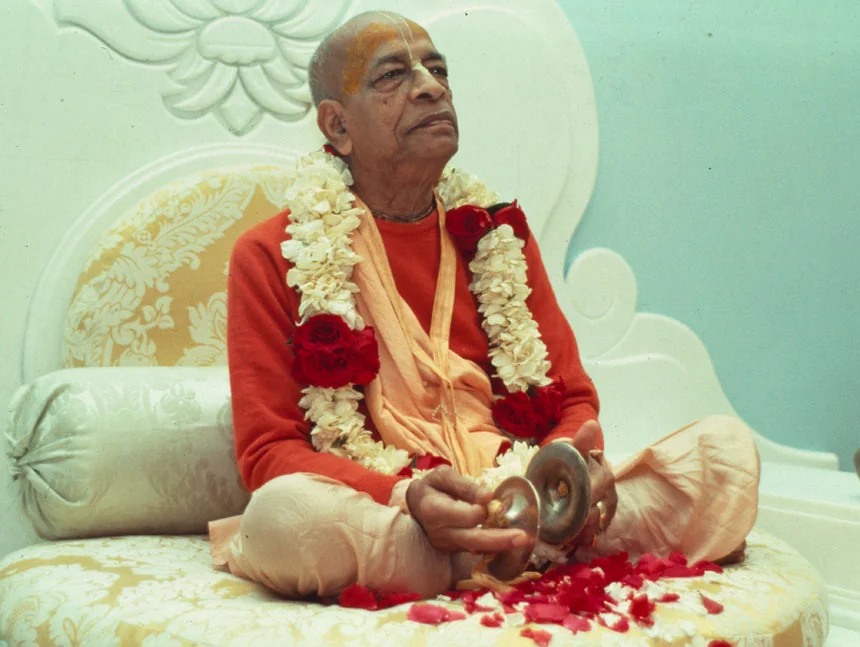
His Divine Grace A.C. Bhaktivedanta Swami Prabhupāda (1896–1977) — the world's most distinguished teacher of Vedic culture and the science of bhakti-yoga.
Born Abhay Charan De on September 1, 1896, in Calcutta, into a devout Vaiṣṇava family. His name means "one who is fearless, having taken shelter at the lotus feet of the Supreme Lord."
At birth, his horoscope was cast by an astrologer who predicted he would one day cross the ocean and open 108 temples worldwide — a prophecy fulfilled in remarkable detail.
In 1922, he first met his spiritual master, Śrīla Bhaktisiddhānta Sarasvatī Ṭhākura, who immediately requested him to preach the message of Kṛṣṇa consciousness in English to the Western world.
He received formal initiation in 1933 and spent the next three decades deeply studying and translating the Vedic scriptures, writing prolifically in preparation for his mission.
In 1944, he single-handedly started Back to Godhead magazine — typing, editing, proofreading, and even funding it himself — which continues to be published today.
In 1959, he accepted the renounced order of life (sannyāsa) and began work on his life's masterpiece — the multi-volume translation and commentary of Śrīmad-Bhāgavatam.
At the age of 69, in 1965, he sailed alone to America on the steamship Jaladuta — carrying only his translations and a few dollars — fulfilling his spiritual master's long-ago instruction.
Arriving in New York City with almost no money and no institutional support, he began chanting the Hare Krishna maha-mantra in Tompkins Square Park, attracting the city's youth.
In July 1966, he founded the International Society for Krishna Consciousness (ISKCON) at 26 Second Avenue, New York.
Within just a few years, his movement spread to every major city in the world. He circled the globe twelve times in eleven years, tirelessly preaching despite frail health.
He established 108 temples, farm communities, gurukula schools and Govinda's restaurants across six continents, creating a complete spiritual civilization.
He translated and commented on over 70 volumes of Vedic literature, including Bhagavad-gītā As It Is, the 18-volume Śrīmad-Bhāgavatam, and the 9-volume Caitanya-caritāmṛta.
His books have been translated into over 80 languages and distributed in the hundreds of millions of copies — making him one of the most widely-read spiritual authors in history.
Scholars from Harvard, Oxford, and major universities worldwide have praised his translations as authoritative and invaluable contributions to world culture and religious scholarship.
He introduced the Ratha Yātrā (Chariot Festival) to the Western world — now celebrated annually in hundreds of cities globally with thousands of participants.
He represents the Brahma-Mādhva-Gauḍīya Vaiṣṇava disciplic succession — an unbroken chain of spiritual masters traceable to Lord Kṛṣṇa Himself through the great sage Vyāsadeva.
His philosophy is grounded in the teachings of Śrī Caitanya Mahāprabhu (1486–1534), who inaugurated the congregational chanting of the holy name as the primary spiritual practice for this age.
He taught the principle of "simple living, high thinking" — spiritual wisdom combined with practical, God-conscious life — as the solution to the world's problems.
He departed this world on November 14, 1977, in Vṛndāvana, India — the sacred birthplace of Lord Kṛṣṇa — surrounded by his loving disciples chanting the holy name.
The title "Prabhupāda" means "one at whose feet the masters sit" — a title of the highest spiritual honour, reflecting his position as a pure devotee of the Lord.
"He lives forever by his divine instructions, and the devotee lives with him." — Śrīla Prabhupāda's instruction ensures his presence remains eternally through his books and recordings.
During his eleven years of active preaching in the West, he personally initiated approximately 5,000 disciples from virtually every nationality, race, and background — an unprecedented gathering of souls around a single spiritual master.
He gave both first initiation (harinama — the chanting of the holy name) and second initiation (brahminical — the Gayatri mantra), conducting grand initiation ceremonies in temples around the world.
His disciples came from all walks of life — students, artists, scientists, scholars, and seekers — and went on to become sannyasis, temple presidents, GBC members, authors, and preachers themselves.
Through his disciples and their disciples, the Vaishnava family has now grown to millions worldwide — all tracing their spiritual lineage back to Śrīla Prabhupāda and the Gauḍīya Vaiṣṇava sampradāya.