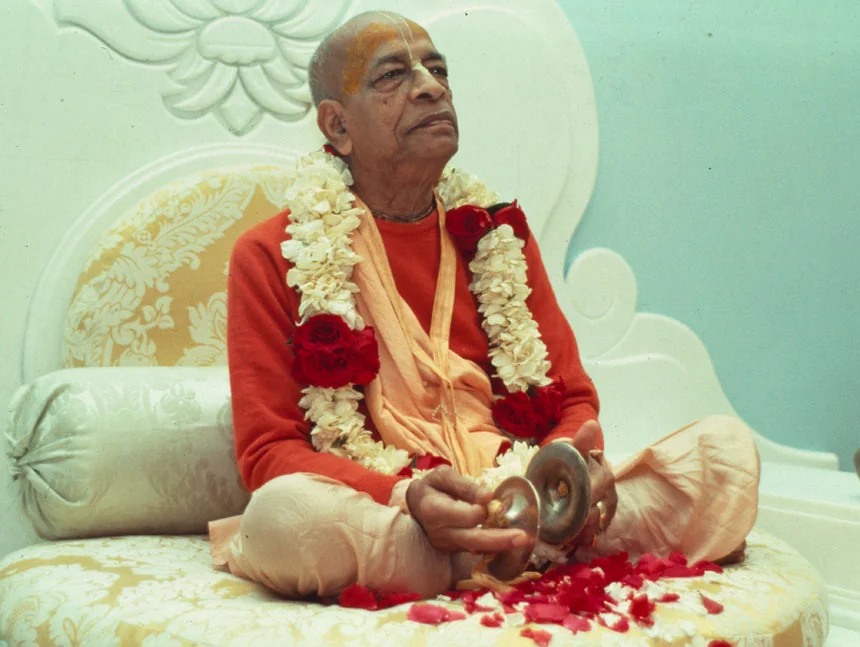
Sincere devotional surrender transcends all material qualifications and family circumstances in pleasing the Supreme Lord.Listen — Srila Prabhupada Uvaca
Śrīmad-Bhāgavatam 7.9.10 — March 11, 1969, Hawaii 690311SB-HAWAII [77:12 Minutes] SB-07.09.10_690311SB-HAWAII Prabhupāda: [sings:] oṁ ajñāna-timirāndhasya jñānāñjana-śalākayā cakṣur unmīlitaṁ yena tasmai śrī-gurave namaḥ [I offer my respectful obeisances unto my spiritual master, who with the torchlight of knowledge has opened my eyes, which were blinded by the darkness of ignorance.] śrī-caitanya-mano-'bhīṣṭaṁ sthāpitaṁ yena bhū-tale śrīmate bhaktisiddhānta-sarasvatīti nāmine [When will Śrīla Rūpa Gosvāmī Prabhupāda, who has established within this material world the mission to fulfill the desire of Lord Caitanya, give me shelter under his lotus feet?] śrī-kṛṣṇa-caitanya prabhu-nityānanda śrī-advaita gadādhara śrīvāsādi-gaura-bhakta-vṛnda [I offer my obeisances to Śrī Kṛṣṇa Caitanya, Prabhu Nityānanda, Śrī Advaita, Gadādhara, Śrīvāsa and all others in the line of devotion.] he kṛṣṇa karuṇā-sindho dīna-bandho jagat-pate gopeśa gopikā-kānta rādhā-kānta namo 'stu te [O my dear Kṛṣṇa, ocean of mercy, You are the friend of the distressed and the source of creation. You are the master of the cowherd men and the lover of the gopīs, especially Rādhārāṇī. I offer my respectful obeisances unto You.] tapta-kāñcana-gaurāṅgī rādhe vṛndāvaneśvari vṛṣabhānu-sute devi praṇamāmi hari-priye [I offer my respects to Rādhārāṇī, whose bodily complexion is like molten gold and who is the Queen of Vṛndāvana. You are the daughter of King Vṛṣabhānu, and You are very dear to Lord Kṛṣṇa.] vāñchā-kalpatarubhyaś ca kṛpā-sindhubhya eva ca patitānāṁ pāvanebhyo vaiṣṇavebhyo namo namaḥ [I offer my respectful obeisances unto all the Vaiṣṇava devotees of the Lord. They can fulfill the desires of everyone, just like desire trees, and they are full of compassion for the fallen souls.] hare kṛṣṇa hare kṛṣṇa kṛṣṇa kṛṣṇa hare hare hare rāma hare rāma rāma rāma hare hare [My dear Lord, and the spiritual energy of the Lord, kindly engage me in Your service. I am now embarrassed with this material service. Please engage me in Your service.] śrī-prahrāda uvāca brahmādayaḥ sura-gaṇā munayo 'tha siddhāḥ sattvaikatāna-gatayo vacasāṁ pravāhaiḥ nārādhituṁ puru-guṇair adhunāpi pipruḥ kiṁ toṣṭum arhati sa me harir ugra-jāteḥ [SB 7.9.8] [Prahlāda Mahārāja prayed: How is it possible for me, who have been born in a family of asuras, to offer suitable prayers to satisfy the Supreme Personality of Godhead? Even until now, all the demigods, headed by Lord Brahmā, and all the saintly persons could not satisfy the Lord by streams of excellent words, although such persons are very qualified, being in the mode of goodness. Then what is to be said of me? I am not at all qualified.] manye dhanābhijana-rūpa-tapaḥ-śrutaujastejaḥ-prabhāva-bala-pauruṣa-buddhi-yogāḥ nārādhanāya hi bhavanti parasya puṁso bhaktyā tutoṣa bhagavān gaja-yūtha-pāya [SB 7.9.9] [Prahlāda Mahārāja continued: One may possess wealth, an aristocratic family, beauty, austerity, education, sensory expertise, luster, influence, physical strength, diligence, intelligence and mystic yogic power, but I think that even by all these qualifications one cannot satisfy the Supreme Personality of Godhead. However, one can satisfy the Lord simply by devotional service. Gajendra did this, and thus the Lord was satisfied with him.] viprād dvi-ṣaḍ-guṇa-yutād aravinda-nābhapādāravinda-vimukhāt śvapacaṁ variṣṭham manye tad-arpita-mano-vacanehitārthaprāṇaṁ punāti sa kulaṁ na tu bhūrimānaḥ [SB 7.9.10] [If a brāhmaṇa has all twelve of the brahminical qualifications [as they are stated in the book called Sanat-sujāta] but is not a devotee and is averse to the lotus feet of the Lord, he is certainly lower than a devotee who is a dog-eater but who has dedicated everything—mind, words, activities, wealth and life—to the Supreme Lord. Such a devotee is better than such a brāhmaṇa because the devotee can purify his whole family, whereas the so-called brāhmaṇa in a position of false prestige cannot purify even himself.] naivātmanaḥ prabhur ayaṁ nija-lābha-pūrṇo mānaṁ janād aviduṣaḥ karuṇo vṛṇīte yad yaj jano bhagavate vidadhīta mānaṁ tac cātmane prati-mukhasya yathā mukha-śrīḥ [SB 7.9.11] [The Supreme Lord, the Supreme Personality of Godhead, is always fully satisfied in Himself. Therefore when something is offered to Him, the offering, by the Lord's mercy, is for the benefit of the devotee, for the Lord does not need service from anyone. To give an example, if one's face is decorated, the reflection of one's face in a mirror is also seen to be decorated.] tasmād ahaṁ vigata-viklava īśvarasya sarvātmanā mahi gṛṇāmi yathā manīṣam nīco 'jayā guṇa-visargam anupraviṣṭaḥ pūyeta yena hi pumān anuvarṇitena [SB 7.9.12] [Therefore, although I was born in a demoniac family, I may without a doubt offer prayers to the Lord with full endeavor, as far as my intelligence allows. Anyone who has been forced by ignorance to enter the material world may be purified of material life if he offers prayers to the Lord and hears the Lord's glories.] sarve hy amī vidhi-karās tava sattva-dhāmno brahmādayo vayam iveśa na codvijantaḥ kṣemāya bhūtaya utātma-sukhāya cāsya vikrīḍitaṁ bhagavato rucirāvatāraiḥ [SB 7.9.13] [O my Lord, all the demigods, headed by Lord Brahmā, are sincere servants of Your Lordship, who are situated in a transcendental position. Therefore they are not like us [Prahlāda and his father, the demon Hiraṇyakaśipu]. Your appearance in this fearsome form is Your pastime for Your own pleasure. Such an incarnation is always meant for the protection and improvement of the universe.] tad yaccha manyum asuraś ca hatas tvayādya modeta sādhur api vṛścika-sarpa-hatyā lokāś ca nirvṛtim itāḥ pratiyanti sarve rūpaṁ nṛsiṁha vibhayāya janāḥ smaranti [SB 7.9.14] [My Lord Nṛsiṁhadeva, please, therefore, cease Your anger now that my father, the great demon Hiraṇyakaśipu, has been killed. Since even saintly persons take pleasure in the killing of a scorpion or a snake, all the worlds have achieved great satisfaction because of the death of this demon. Now they are confident of their happiness, and they will always remember Your auspicious incarnation in order to be free from fear.] [05:36] So Prahlāda Mahārāja offering prayers to Lord Nṛsiṁhadeva. The verses are fifty. Fifty verses. The each and every line is so important that all Vaiṣṇavas, they have picked up these prayer as very important within the Śrīmad-Bhāgavatam śāstra, scripture.
So Prahlāda Mahārāja is saying that, viprād dvi-ṣaḍ-guṇa-yutād aravinda-nābhapādāravinda-vimukhāt śvapacaṁ variṣṭham [SB 7.9.10] [If a brāhmaṇa has all twelve of the brahminical qualifications [as they are stated in the book called Sanat-sujāta] but is not a devotee and is averse to the lotus feet of the Lord, he is certainly lower than a devotee who is a dog-eater but who has dedicated everything—mind, words, activities, wealth and life—to the Supreme Lord. Such a devotee is better than such a brāhmaṇa because the devotee can purify his whole family, whereas the so-called brāhmaṇa in a position of false prestige cannot purify even himself.] Śvapacaṁ. Śva means dog, and pacaṁ means cooking. So in the human society, the lowest class of men are considered the dog-eaters. In the Manu-saṁhitā there is a list of different kinds of men eating different kinds of flesh, and in the Āyurveda there is a list of dravya-guṇa. Dravya-guṇa means medical effect of certain type of things.
So that is a very big book, and all kinds of vegetables, all kinds of flesh, all kinds of fish and everything is detailed there, and there is description what is the effect of eating such-and-such things. So it is not that the Vedic civilization does not know what is the effect of eating flesh. They have got very broad analytical knowledge, and in the recent years Mr. George Bernard Shaw, he also said that "You are what you eat." So if you eat a certain type of food, then your constitution of the body, mentality, status—everything—becomes according to that food. That is a fact. So there is a class of men who are called śvapaca. Śvapaca means dog-eaters.
So the dog-eater is called caṇḍāla, pañcama. The human society is divided into four: first class, second class, third class, fourth class, and pañcama means fifth class. So these dog-eaters, they are considered as the fifth class. Those who are flesh-eaters, they are fourth class, and those who are vegetarians, they are first class, second class, third class. And those who are animal-food eaters, they are fourth class; and less than that, those who have no distinction of eating any kind of flesh...
There are certain classes of nation also. They say the Chinese people, they eat anything. So a man is considered to be situated at a certain status of civilization according to the modes of material nature, and that is manifested by eating, by behaving. Ācāra, vicāra. Ācāra means behavior, and vicāra means judgment. By advancement of education one becomes fixed up to take things by judgment. That is called vicāra.
And ācāra means cleanliness or behavior. So ācāra, vicāra. The first-, second- and third-class human being, they are situated in ācāra and vicāra. And in modern civilization also, they say sometimes that a nation is calculated how far he is civilized by the conjunction of amount of soap. That means..., the soap-using nation means that cleansed.
So cleanliness is still considered as the civilized status of man. Unclean status... There are different kinds of cleanliness. Inside, vacaḥ bhyantaraṁ.